A glossy factory spec sheet tells you almost nothing about whether a supplier will deliver reliable equipment on time. When you are sourcing a commercial kfc style pressure fryer for a restaurant chain, distribution catalog, or central kitchen, you have to judge the manufacturer on pressure-vessel engineering, actual manufacturing capacity, and whether they will show you their real production floor. Before you shortlist suppliers from our commercial pressure fryers buyer’s guide, use this sourcing framework to separate real manufacturing plants from trading company middlemen.
Table of Contents
- What a KFC-Style Pressure Fryer Actually Is
- Pressure Vessel Engineering Is the First Test
- Can the Factory Actually Produce at Volume
- Certifications and What They Do Not Prove
- MOQ, Lead Time, and the First Order
- OEM and ODM for Private-Label Buyers
- Spare Parts Decide How Long the Fryer Lasts
- A Vetting Checklist Before You Pay a Deposit
1. What a KFC-Style Pressure Fryer Actually Is
A KFC-style pressure fryer is a specialized heavy-duty machine built around a cylindrical round fry pot and a heavy locking lid mechanism. Unlike square open vats, a round cooking well prevents flour and batter from getting trapped in square corners where it burns.
The bottom of the pot features a deep cold zone designed to collect loose breading and bone dust away from the heating elements or gas burners. Because these machines trap steam to cook bone-in chicken roughly 30% faster than an open vat, they operate as pressurized vessels. That engineering distinction means your manufacturer selection process cannot follow the same rules you use to buy stainless steel prep tables or refrigerators.
2. Pressure Vessel Engineering Is the First Test
A pressure fryer is not a standard sheet-metal box. It is a pressurized cooking vessel holding boiling oil and steam under positive pressure. If a supplier cuts corners on welding quality, metal thickness, or pressure relief safety valves, the equipment becomes a severe workplace hazard.
When evaluating a manufacturer, ask for detailed technical documentation on how the fry pot is fabricated:
- Weld integrity: The seams on a pressure vessel must be precision-welded and pressure-tested to handle continuous thermal expansion and steam cycles. Ask if welds are inspected or pressure tested before assembly.
- Lid locking and sealing: The spindle, crossbar, and lid-locking mechanism must lock down securely against a high-temperature silicone or rubber gasket without warping under heat.
- Safety relief valves: A reliable unit must include backup pressure-release valves and mechanical interlocks that prevent the operator from opening the lid while internal steam pressure is present.
If a supplier cannot explain their pressure testing procedures or sends vague drawings, walk away.
3. Can the Factory Actually Produce at Volume
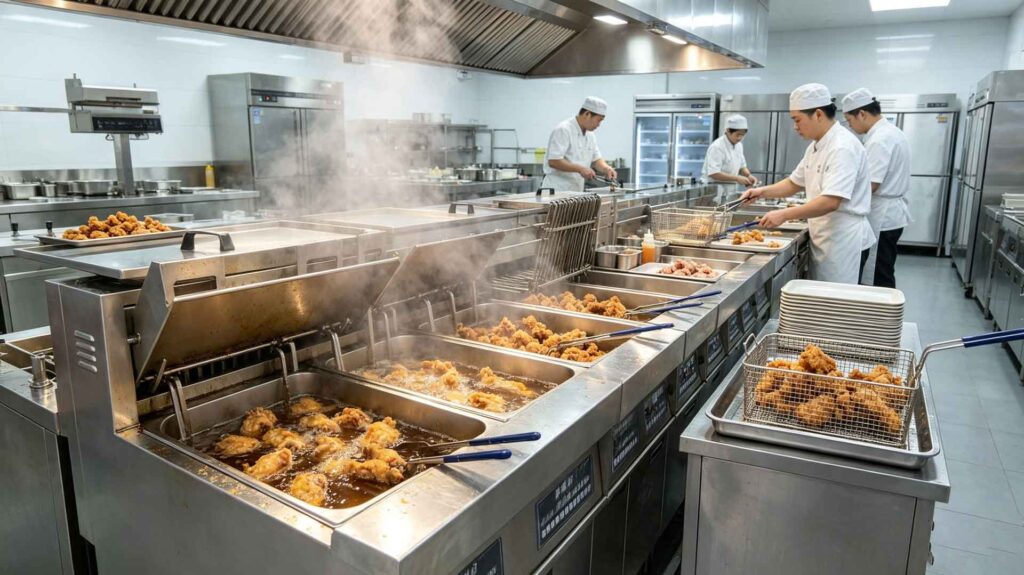
Many websites claiming to be equipment manufacturers are actually small trading offices or assembly-only workshops that buy parts from a dozen different subcontractors and bolt them together in a rented garage. When an order spikes, they miss deadlines because they do not control their own supply chain.
Ask to see the physical scale of the operation:
- Floor size and layout: Look for dedicated sheet-metal laser cutting bays, robotic welding stations, pressure testing zones, and electrical assembly lines under one roof. For instance, Dalin operates a 50,000 m2 production campus with a monthly output of 15,000 units, allowing strict quality control over every fabricated cabinet and fry pot.
- In-house fabrication versus outsourcing: Ask which components are stamped and welded in-house. A real manufacturer controls its metal fabrication, while a trading company forwards your order to the lowest bidder.
- Pressure testing, not just welding: Every vessel needs to be pressure tested before it ships. Ask whether testing happens on the line for every unit or whether it is only done for sample orders. A factory that skips per-unit testing on a pressure vessel is telling you the vessel matters less to them than the invoice.
- Ask to see a machine on the floor, not a showroom unit: The clean display model at reception tells you nothing. You want to see a unit in mid-build with the pot open and the panels off.
- Watch what is outsourced: Sheet metal, castings, and control boards are the components most often bought in. That is normal and fine. It becomes a problem when the supplier cannot tell you which parts they make themselves and which they buy, because they do not know.
If you have already decided between fryer types and need a shortlist of what to check on any of them, our pressure fryer vs open fryer comparison covers the operational differences, and the buyer’s guide covers capacity and control panels.
4. Certifications and What They Do Not Prove
Every supplier website lists standard quality badges, but certificates are only as good as the testing lab behind them. A photocopy of a CE logo pasted onto a PDF means nothing if the actual unit has never been tested by an accredited laboratory.
When vetting compliance:
- CE, REACH, and RoHS: Verify that the supplier holds legitimate CE certification for safety and health standards, alongside REACH and RoHS compliance verifying that electrical components and internal wiring are free from restricted toxic substances.
- ISO 9001 quality management: Check that the factory operates under an audited ISO 9001 quality management system governing incoming material inspection, production assembly, and final factory testing.
- Match the certificate: Ask for the official certificate number and the name of the issuing testing agency, then verify the registration online.
5. MOQ, Lead Time, and the First Order
If a manufacturer insists on a minimum order quantity of fifty units just to test their equipment, they are not set up to support growing distributors or multi-store operators.
- MOQ flexibility: Look for a supplier that supports an MOQ of 1 unit for sample evaluation or single-store trials. A factory confident in its build quality lets you test one machine before discussing container loads.
- Lead time reality: Ask how long it takes to ship a standard 25L floor model. Dalin maintains a 7 to 10 working days lead time, which keeps a restaurant launch or inventory replenishment on schedule.
- What the quoted lead time actually covers: Find out whether the number runs from deposit to loading, or from loading to arrival at your port. A supplier quoting two weeks end to end while production alone takes one week is telling you something. Ask what happens to the schedule if you change the control panel three weeks in.
- Reading a quoted lead time against capacity: If a factory claims monthly output of thousands of units and quotes you the same lead time as a small workshop, one of the two numbers is inflated. Ask what the current production schedule looks like and whether your order goes into an existing batch or starts a new line.
Your first order is a sample, not a commitment. Pay for one machine, run it through a full week of service, and see how the factory responds when you email about a part.
6. OEM and ODM for Private-Label Buyers
If you are a distributor building a private-label equipment line or a restaurant chain wanting custom branding, you need a factory with real OEM and ODM engineering support.
- Custom branding and panels: A capable manufacturer should customize exterior stainless steel body panels, laser-cut logo branding, and control panel layouts. Whether you order a pressure fryer with filtration or an electric vs gas pressure fryer, the build should adapt to your specifications.
- Control interface options: Dalin offers four control systems on its 25L line: mechanical, digital, programmable, and smart panels, giving private-label buyers flexibility across price tiers.
- Tooling and minimum quantities for custom panels: A new panel layout or screen-printed logo needs tooling. Ask who pays for it, whether the tooling is exclusive to you, and what quantity triggers the custom price. A supplier who will not discuss tooling costs usually has a policy that changes the moment you order.
- Who owns the artwork: Ask whether your logo files and artwork belong to you once production starts, and whether the supplier can use them for other customers. Distributors building a private line get burned by unclear artwork ownership more often than by unit price.
Get one sample unit in your own branding before committing to a container. A sample that arrives with the wrong badge or panel layout is a shipping error you want to find at sample stage, not after a hundred units are at sea.
7. Spare Parts Decide Long-Term Reliability
Even the best-built commercial kitchen equipment will eventually need a replacement part. A heating element, a temperature probe, or a lid gasket wears out after thousands of fry cycles. If your supplier cannot ship a replacement part within a week, your customer’s restaurant is left with a dead machine.
Before signing a purchase agreement, check their after-sales support infrastructure:
- Warranty coverage: Look for a clear, uncompromised warranty. Dalin provides a 1-year warranty plus lifetime technical support, giving your local service technicians direct access to wiring diagrams and troubleshooting guides.
- Consumable parts availability: Ask if they stock common wear items—such as lid gaskets, drain valves, filter paper, and pump O-rings—ready for immediate air freight dispatch.
8. A Vetting Checklist Before You Pay a Deposit
Use this comparison table during your next video call or supplier audit to separate reliable manufacturers from high-risk trading companies.
| Vetting Category | Common Supplier Red Flag | What Good Looks Like |
|---|---|---|
| Factory Footage | Refuses video tour, claims “we have multiple partner plants” | Walks you through a real 50,000 m2 production campus |
| Pressure Testing | Says “our machines don’t leak, testing records are secret” | Shares documented pressure-vessel weld inspection and testing SOPs |
| Certifications | Sends unverified Jpeg logos or expired certificate copies | Provides traceable CE, REACH, RoHS, and ISO 9001 certificates |
| Minimum Order | Demands 50-unit MOQs for a first-time test order | Supports a 1-unit MOQ so you can test build quality firsthand |
| Production Lead Time | Vague promises like “whenever the container is ready” | Clear 7 to 10 working days production lead time |
| Spare Parts Support | Tells you to buy generic parts locally if something breaks | Stocks dedicated OEM replacement components with lifetime technical support |
FAQ
How do I verify a pressure fryer factory is real?
Ask the supplier for a live video call walkthrough of their active production floor. A real manufacturer will show you metal laser-cutting machines, welding bays, assembly lines, and testing stations, whereas a trading company will hesitate or try to show you stock showroom photos.
What is a reasonable MOQ for a first order?
A customer-focused manufacturer will offer a 1-unit MOQ for initial sample testing or single-store trials. Demanding a high MOQ before letting you inspect sample build quality is a major red flag.
Which certifications should a commercial pressure fryer have?
A commercial pressure fryer must hold CE safety certification, along with REACH and RoHS compliance for electrical and material safety. The manufacturing facility itself should operate under an audited ISO 9001 quality management system.
Can I get a private-label KFC-style fryer?
Yes. Experienced manufacturers offer OEM and ODM customization services, allowing you to add your company logo, customize control panel layouts, and adjust equipment configurations to match your distribution catalog or chain standards.
How do I check a claimed lead time?
Ask the factory what their current component stock is and how many units they produce per month. A plant with high monthly output, such as Dalin’s 15,000-unit capacity, easily maintains reliable 7 to 10 working days lead times for standard orders.
What should be in the warranty?
Look for a manufacturer offering a 1-year parts warranty backed by lifetime technical support. This ensures your local technicians can always get direct wiring diagrams, troubleshooting help, and replacement components.
Conclusion
Choosing the right manufacturer for a KFC-style pressure fryer requires looking past marketing claims to inspect vessel safety, manufacturing scale, and parts support. By partnering with an audited factory offering 1-unit sample MOQs, verified CE and ISO 9001 compliance, and technical support that answers your questions, you protect your business from costly equipment failures.
Ready to discuss your distribution or restaurant chain requirements? Explore our commercial pressure fryer lineup to request factory-direct specifications, discuss custom OEM branding, or schedule your first sample order today.