Most operators only think about the booster heater when something goes wrong. The rinse comes out lukewarm, a health inspector asks for a temperature log, and someone opens a cabinet expecting a burner and finds a small electric element instead. By then the machine is already installed.
It works the other way round. A commercial dishwasher booster heater is the part of the machine that decides whether your wash line can pass a temperature check, and it determines how many racks the machine pushes through an hour. Understanding it before you buy is cheaper than troubleshooting it after.
Table of Contents
- Why 82-85°C Is the Line That Matters for Sanitizing
- Three Ways a Commercial Dishwasher Heats the Rinse Water
- Sizing the Commercial Dishwasher Booster Heater: The kW Calculation
- Electrical, Water and Air Gap Requirements
- Water Hardness and the Warranty Condition Everyone Misses
- Verifying Sanitizing Temperature on Commissioning Day
- Common Booster Failures and the Red Flags in a Quote
- Choosing Between Electric, Gas and Heat Recovery
1. Why 82-85°C Is the Line That Matters for Sanitizing
Sanitizing with heat is a combination of two numbers: how hot the water is, and how long the item sits in it. Most commercial dishwashers in Europe and North America work to a final rinse band of 82-85°C, which corresponds to 180-185°F. Below that band the rinse no longer kills the bacteria that survives the mechanical action of the wash.
Here is where the confusion starts, and it costs buyers real money. The wash tank of a commercial machine typically runs at 55-60°C. That is a cleaning temperature. It loosens grease and lifts dried food off the plate, but it does not sanitize. The sanitizing step is the final rinse, and the final rinse water has to reach the 82-85°C band on its own, every cycle, without a break.
That is a harder job than heating the wash tank, for two reasons. The rinse water is sprayed onto the item as a thin film, so the whole volume of water has to be brought to temperature quickly and continuously. And the incoming water is cold, so every cycle pulls a fresh charge of cold water into the circuit that the heater has to replace.
If you remember one thing about the booster heater, remember this: it does not make the wash hotter, it makes the rinse hot enough to sanitize. A machine with a weak booster washes beautifully and still fails a temperature check. Whether you need a booster at all depends on the machine format, and the hood type versus undercounter comparison covers how the two differ on wash volume and labour.
| Rinse water temperature at the plate | Sanitizing outcome |
|---|---|
| Below 65°C | Cleaning only. No thermal disinfection takes place. |
| 65-79°C | Inconsistent. Some item types sanitize, others do not, and the result varies with load. |
| 80-82°C | Borderline. Passes on a single empty rack test, drops below under continuous load. |
| 82-85°C | The standard sanitizing band. This is what you are buying a booster for. |
| Above 90°C | Unnecessary energy use. Raises element load and shortens machine life without adding safety. |
2. Three Ways a Commercial Dishwasher Heats the Rinse Water
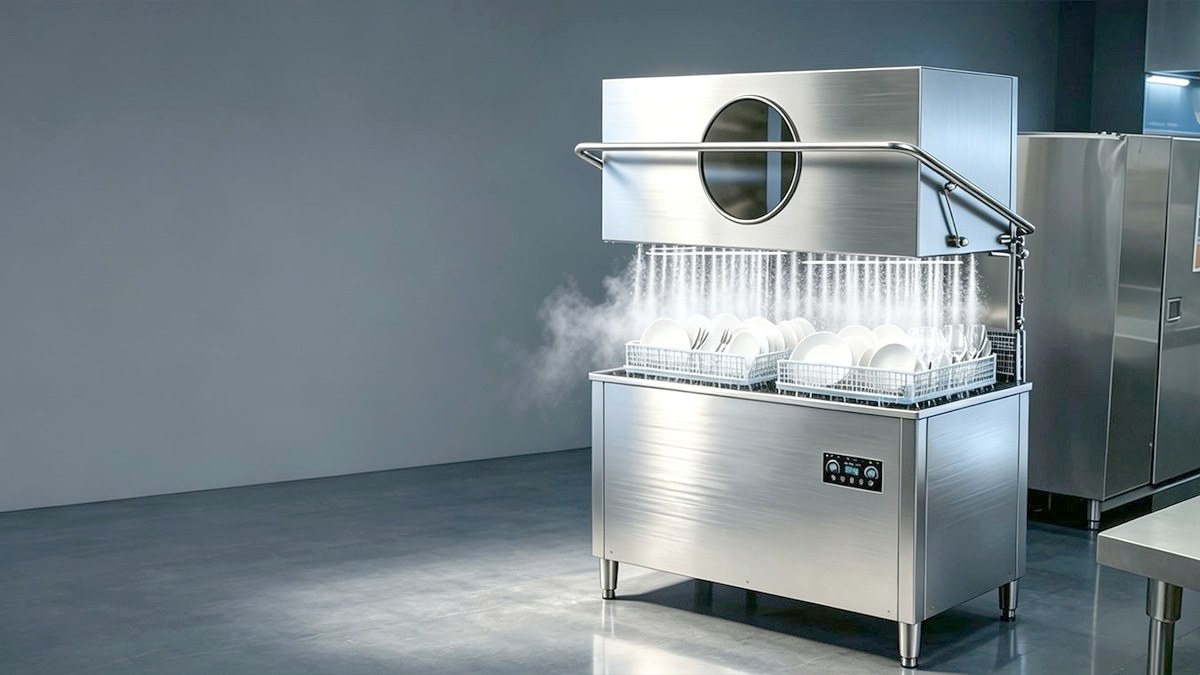
There are only three practical ways to get the rinse water into the 82-85°C band, and a commercial dishwasher booster heater comes in one of three forms. They differ in more than the fuel they burn.
Built-in electric rinse heater. The element sits inside the machine’s rinse tank and brings the water up with electricity. This is the arrangement most often described simply as a dishwasher booster heater, and it is the one to check first when a supplier says the machine comes with a booster. This is the most common arrangement on smaller and mid-size machines because it needs no separate pipework and no gas connection. The trade-off is electrical capacity: the element is a continuous load that competes with every other appliance on the same supply.
Separate booster heater. A standalone unit plumbed into the rinse circuit, holding its own small tank and pumping into the machine. This is where the term commercial dishwasher rinse heater usually applies, and it is also where most of the accessory catalogue confusion starts. Buyers choose this when the machine has no rinse heater, when the electrical supply is already tight, or when they want the temperature held independently of the wash cycle. It is also the arrangement behind most accessory catalogues, which is why the phrase “booster heater” shows up so often in equipment searches.
Gas or heat recovery. A gas-fired burner heats the rinse water with flame instead of an element. Heat recovery takes a different route: it captures waste heat from the machine’s own operation, or from a heat source in the kitchen, and uses it to preheat the rinse supply. Heat recovery is the most efficient option when it is available, because the energy is already paid for somewhere else.
Dalin builds the gas path directly into the range with the DL-D3 gas type hood dishwasher, which raises water temperature with gas instead of electricity. On a line running near continuous service, that difference shows up in the monthly utility bill rather than in the spec sheet.
| Approach | Typical application | What it costs you | Main limitation |
|---|---|---|---|
| Built-in electric rinse heater | Under-counter and small pass-through machines | Lowest install cost | Draws from the same supply as the wash heater |
| Separate electric booster | Machines without a rinse heater, sites with spare capacity | Extra unit, pipework, a second electrical circuit | Needs somewhere to put it |
| Gas burner rinse heat | High-volume pass-through lines, central kitchens | Gas connection and a licensed install | Not available at every site |
| Heat recovery | New builds and refurbishments with a heat source available | Lowest running cost | Needs a recoverable heat source nearby |
3. Sizing the Commercial Dishwasher Booster Heater: The kW Calculation
Sizing a booster means answering one question: how much cold water has to reach 82°C, and how fast?
The physics is straightforward. Water needs roughly 4.2 kJ per kilogram per degree Celsius. Lift a kilogram of water by 70 degrees and you have spent about 294 kJ. One kilowatt delivers one kJ per second, so heating one kilogram of water from 12°C to 82°C takes about 70 seconds on a 1 kW element.
The useful formula for a buyer is this:
Booster kW = (Litres per cycle x 4.2 x Temperature rise in °C) / (Cycle time in seconds x Efficiency factor)
Run it for your actual rinse flow, not the brochure number, and you will get a figure that means something.
Worked example 1, a single-basket line. Take a machine washing 60 baskets per hour with a rinse flow of 4 litres per basket. That is 240 litres an hour moving through the rinse circuit. If incoming water is 12°C and the target is 82°C, each litre needs 4.2 x 70 = 294 kJ. Across 240 litres that is 70,560 kJ per hour, or 19.6 kW of continuous energy. Applying an efficiency factor of about 0.9 for heat loss through the tank and pipework gives roughly 21.8 kW. That is the connected load you are signing up for on the electrical supply.
Worked example 2, a double-basket line. A DL-D2 double basket machine running 120 baskets per hour doubles the rinse flow to 8 litres per basket, or 960 litres an hour. The same calculation gives 78.4 kW before losses, and about 87 kW connected. A machine like that is usually three-phase, and on many sites it needs its own dedicated circuit rather than a shared supply.
Two things fall out of these numbers that buyers rarely see stated plainly. First, the connected load of a booster is not a rounding error next to the machine: at 120 baskets per hour, the booster can draw more power than everything else in the dish area combined.
Second, once you know the number, you can compare it against what your electrical supply can actually give you. If the calculation does not fit the panel, the conversation has to happen before the machine is ordered, not after it is installed.
| Throughput target | Rinse flow | Connected load for 82°C from 12°C | Supply implication |
|---|---|---|---|
| 60 baskets per hour | 4 litres per basket | About 22 kW | Single phase possible at the lower end, three phase safer |
| 120 baskets per hour | 8 litres per basket | About 87 kW | Three phase, dedicated circuit, check the panel |
| Heat recovery applied | Same flows | Load largely removed from the electrical supply | Needs a recoverable heat source |
Throughput is the input to this calculation, and getting it right before you start is where the real savings sit. We break down how to convert covers into baskets per hour in detail in how to size a commercial dishwasher.
4. Electrical, Water and Air Gap Requirements
The booster sits in the middle of a compliance conversation, so it is worth being precise about what a supplier should be able to tell you.
Electrical. Ask for the connected load in kW, the voltage, the phase count, and the required breaker size. Ask whether the booster can run independently of the machine’s wash heater, because on some sites you will want the rinse temperature held even while the wash tank is idle. A supplier who cannot state these three numbers has not engineered the machine.
Water supply. Most health codes and most manufacturer installation manuals require a backflow preventer (often called an air gap or a break tank) between the incoming water supply and the machine’s rinse circuit. The reason is simple: the machine’s tank is a contaminated-water environment, and a pressure drop in the line can otherwise pull that water back into the potable supply.
Air gap. Where the local code demands a physical air gap rather than a valve, the machine needs to be installed with the tank and the feed arranged so nothing can siphon. Ask the supplier which arrangement they supply as standard, because retrofitting it later means moving the machine.
Water hardness. This one deserves its own section, and it is covered next because it is the single most expensive omission in a booster purchase.
| Item to confirm on any booster quote | Why it matters |
|---|---|
| Connected load in kW | Decides the circuit, the breaker and the panel upgrade |
| Voltage and phase | A single-phase site cannot take a three-phase booster |
| Minimum incoming water pressure | Low pressure means longer recovery and unstable plate temperature |
| Maximum incoming water hardness | Above the limit, the element scales and warranty is void |
| Backflow protection supplied | A retrofit means moving the machine later |
| Recovery time at full load | The number that tells you the real baskets per hour |
5. Water Hardness and the Warranty Condition Everyone Misses
Scale is the quiet killer of booster heaters. Hard water carries calcium and magnesium salts, and when the rinse water is held at 82-85°C those salts precipitate onto every internal surface. The heater element is the worst place for this, because the insulating crust cuts heat transfer, so the element has to run hotter to deliver the same water temperature.
The consequences arrive in a predictable order. First, the recovery time after a cold fill gets longer. Second, the element runs at a higher temperature and starts to fail earlier. Third, spray nozzles in the rinse arm block, and the plate temperature becomes uneven. By the time the machine is out of warranty, the scale is the reason and the hard water is invisible in the paperwork.
The number most manufacturers work to is around 150 ppm as calcium carbonate. Above that, a water softener is not optional.
The money and the risk sit here. Read the warranty terms before you order. Many manufacturers state that hard water use voids the element warranty, and they can often tell it. Scale on the element leaves a visible crust, and on the tank it leaves a hard deposit that does not come off without chemicals. If you order a machine with an open tank element and run it on 300 ppm water without a softener, you have made a decision, not an oversight. Some suppliers will not honour the claim, and some will honour it but charge you for the element and the tank clean.
Install a softener. On a high-output line the cost of the softener is small next to the machine, and it is the difference between a ten-year element and a three-year one. When you build the budget, treat the softener and the first year of consumables as line items rather than afterthoughts. Our commercial dishwasher cost breakdown sets out the full running cost structure including treatment equipment.
| Incoming water hardness | What to install | Warranty position |
|---|---|---|
| Below 60 ppm | No treatment needed | Normal terms apply |
| 60-150 ppm | Softener strongly advised | Usually still covered, but confirm in writing |
| Above 150 ppm | Softener required | Hard water use commonly voids the element warranty |
| Above 250 ppm | Softener plus periodic descale | Treat as an ongoing operating cost in your budget |
6. Verifying Sanitizing Temperature on Commissioning Day
The booster is specified, installed and powered. Now you need to know whether it actually works, because a machine that passed a single empty rack test on delivery day will still fail an inspection three months later.
Two tools do the job. A waterproof maximum-registering thermometer gives you the peak temperature reached at the plate surface. Thermolabels, the self-adhesive strips that change colour irreversibly when exposed to a given temperature, are the cheap and permanent option: fix one inside a rack, run the machine, and the strip tells you what the surface actually reached. Many operators keep a dated strip in each machine as part of their food safety file.
The method matters more than the tool. Run ten to fifteen racks back to back without pause. A machine running on empty racks in a quiet morning will hold temperature easily. The failures happen when the wash line is under load and the booster has to reheat between cycles.
Record three numbers: the temperature at the first rack, the temperature at the last rack of the continuous run, and the time the machine took to recover after a cold fill. Those three numbers, written down on the commissioning sheet, are the evidence you will need when the health inspector asks.
| Check | Method | Pass condition |
|---|---|---|
| Plate surface temperature | Thermolabel inside a rack, or max-registering thermometer | Reaches the 82-85°C band |
| Temperature under continuous load | Ten to fifteen racks back to back, no pause | Last rack still in band |
| Cold recovery time | Time from cold fill to first in-band rinse | Within the supplier’s stated figure |
| Rinse arm flow | Visual check at full water pressure | All jets present, no blocked nozzles |
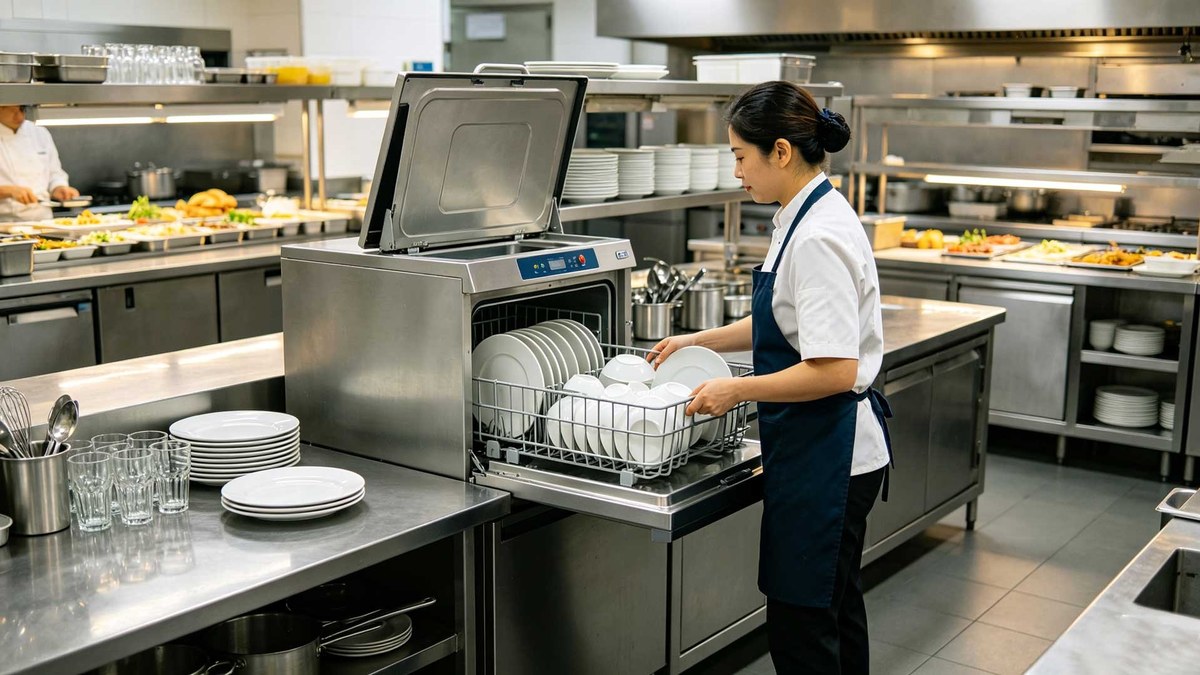
7. Common Booster Failures and the Red Flags in a Quote
Booster problems are easy to misdiagnose because the symptom appears somewhere else. The plate comes out warm and the operator blames the wash. The machine trips a breaker and the electrician suspects the pump.
Here are the failures you will actually meet, and the warning signs that should appear in the quote before you sign.
Scale on the element. The most common failure by a wide margin. Symptom: recovery time gets longer, the element draws more current, plate temperature falls at the end of a busy service. Warning sign in the quote: no mention of inlet water hardness limits, and no softener in the scope of supply.
Undersized booster. Symptom: passes a single rack test, drops below the band under load. Warning sign: the supplier quotes “baskets per hour” but gives no connected load, so you cannot check whether the booster can support that figure.
Booster plumbed into the wash circuit by mistake. Symptom: wash tank temperature climbs above its setpoint and the machine trips on over-temperature. Warning sign: the installation drawing is missing, or the same diagram is used for every model.
Thermostat drift. Symptom: temperature is fine in the morning and low in the afternoon, tracking with room temperature or with a busy kitchen. Warning sign: no calibration interval in the maintenance schedule.
Single point of failure. Symptom: one component takes the whole machine offline. Warning sign: a single element, no bypass, and no way to hold sanitizing temperature while the element is replaced.
The single most useful question you can ask a supplier about the booster is: what is the connected load, and does the machine still hit 82-85°C at the last rack of a fifteen-rack continuous run? A supplier who answers both numbers has engineered the machine. A supplier who answers only with baskets per hour is selling you a brochure figure. The wider vetting routine, including the other questions worth putting into an RFQ, is covered in our hood type dishwasher buying guide.
8. Choosing Between Electric, Gas and Heat Recovery
By the time you reach this section you have the numbers. The choice is usually between electrical capacity, gas availability and running cost, in that order.
Start with what your site can supply. If the electrical panel has no spare three-phase capacity and the site has no gas, the decision is made for you and you should be looking at heat recovery instead of a bigger booster.
Then check the running cost against your service volume. At low volume, a booster rarely runs continuously and the difference between electric and gas is small. At high volume, where the booster reheats between every rack, gas is materially cheaper per unit of heat. The DL-D3 gas type hood dishwasher takes the gas path as standard, and on a line running 120 baskets per hour that is worth modelling before you order.
Then check whether heat recovery is available. If the site has a heat source that can be recovered, or if the machine can recover its own waste heat, the electrical load largely disappears from the equation. This is the most efficient option and it is often the least obvious one, because nobody puts it on the equipment list.
Then look at the service implications. Electric elements are cheap to change and any competent technician can do it. Gas burners need a licensed gas fitter. A heat recovery system may need a separate heat source maintained by someone else. For a site far from a major equipment hub, the spare parts and service response matter as much as the fuel.
Finally, the water. Whatever heating route you choose, the softener goes in. Every configuration on this page fails the same way without it. The machine side of the calculation is covered in our hood type dishwasher buying guide, which shows how to write the specification a supplier will quote against.
Request a Quote
Send us the incoming water hardness reading, the electrical supply details and the baskets per hour you need to hit, and we will come back with a specification from our hood type dishwasher range.
Dalin builds the hood type range in three configurations, the DL-D1 single basket at 60 baskets per hour, the DL-D2 double basket at 120 and the DL-D3 gas heated variant, with CE, REACH, RoHS and ISO 9001 certification across the range. The line runs out of our own 50,000 square metre plant in Dongguan, where 74 engineers work on a monthly output of 15,000 units and 18 years of export experience sits behind the drawings.
Our engineers can review your floor plan, produce 2D CAD and 3D layout drawings and specify the machine and the heating route for your local power and gas supply. Tell us your kitchen dimensions, your peak meal volume and your water hardness, and we will return a factory quotation with the booster load calculated in.
FAQ
What temperature does a commercial dishwasher need to sanitize dishes?
Most health codes require the final rinse water to reach 82-85°C (180-185°F) at the plate surface for a set contact time. Dishwashers reach that band either with a built-in heater or with a separate booster heater, and many local codes also require the machine to display or log the achieved temperature.
Can I add a booster heater to a dishwasher that already has one?
Sometimes, but check the nameplate first. If the machine has a wash heater but no rinse heater, a separate booster can be plumbed into the rinse circuit, provided the machine’s rinse spray arm and pump can handle the added flow and the electrical supply has spare capacity. For a machine with a working rinse heater, adding a second one is usually wasted money.
Does a booster heater use more electricity than the washing element?
Often yes. A wash element heats the main tank a few degrees per cycle and runs intermittently. A booster has to bring fresh incoming water all the way up to sanitizing temperature in a short window, so it carries a much higher connected load. On an electric machine this is often the largest single electrical draw in the whole kitchen.
What water hardness breaks a dishwasher booster heater?
Hardness above roughly 150 ppm (as calcium carbonate) causes scale to build up inside the booster tank and on the heating element. The insulating crust cuts transfer efficiency, the element runs hotter and fails earlier, and most manufacturers treat hard water as a warranty exclusion. A water softener is the fix, and it is frequently a condition of warranty rather than a recommendation.
Is a gas-heated booster better than an electric one?
Gas heats water faster and costs less per unit of heat at commercial gas rates, which matters for high-volume lines. Electric is simpler, has no gas connection to install, and is easier to control precisely. For a high-output pass-through line running near continuous service, gas wins on running cost. For a small kitchen or a site with no gas available, electric is the only realistic option.
How long does a commercial dishwasher booster heater last?
A properly scaled booster on softened water should give many years of service. The common failure mode is not the element itself but scale: an unscaled element eventually runs hotter, draws more current, and fails. Hard water plus no softener is what shortens booster life, not the hours of operation.
Why does my dishwasher pass temperature checks in the morning but fail later?
The booster has recovered its temperature and the check passes on the first few racks. Then a porter loads racks back to back, the rinse boiler draws fresh cold water faster than the element can reheat it, and the plate surface temperature drops below the sanitizing band. A single pass test proves nothing. You need a continuous-load test.