The decision between a commercial electric pressure fryer and a gas model is usually made by the utility lines already waiting at your kitchen wall, not by personal preference. Before you browse options in our commercial pressure fryers buyer’s guide, you need to check your building supply. A gas line with too low of a pressure rating or an electrical panel missing three-phase power will veto your preference before the equipment ever leaves the shipping crate.
Table of Contents
- Which One Comes Down to Your Utilities
- How Each One Heats the Oil
- What Installation Actually Requires
- Recovery and Temperature Control in Service
- Ventilation and Kitchen Heat
- The Running Cost Question
- Electric vs Gas Side by Side
- Which Fits Which Site
1. Which One Comes Down to Your Utilities
Restaurant operators often spend days debating burner BTUs versus electrical kilowatts, only to find out their landlord will not let them run a new gas flue or their electrical panel has zero spare breaker space.
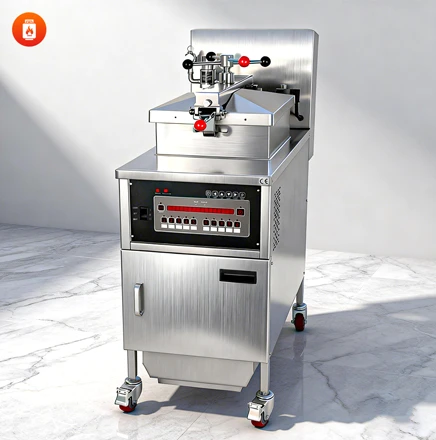
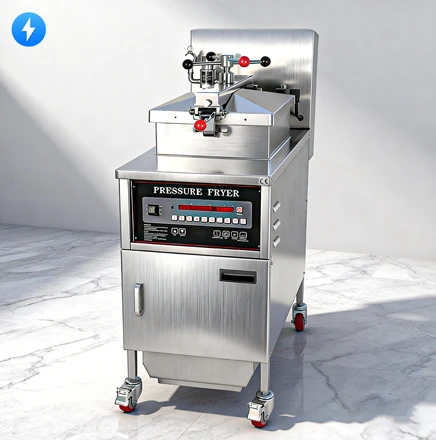
When you look at our 25L floor-standing line, the machine chassis is built to accept either heating method. Both versions house the same under-pot filtration pump, and both let you pick from mechanical, digital, programmable, or smart control panels. The machine does not care which fuel you feed it. Your building inspector and utility bill care a great deal.
2. How Each One Heats the Oil
Electric and gas models heat shortening differently, and a cook standing on the line will notice the difference in how the pot reacts during a rush.
An electric pressure fryer immerses heavy-duty heating elements directly into the oil or wraps them tightly around the exterior pot walls. Almost all of the electrical energy goes straight into the shortening. Very little heat escapes into the surrounding room, making electric units popular in tight spaces or buildings with minimal air conditioning.
A gas pressure fryer uses high-output atmospheric burners or infrared burners that fire into heat exchanger tubes running through the fry pot or around an external jacket. Gas delivers high raw thermal energy right at the pot wall. When a cook drops a multi-head batch of cold chicken into the pot, gas burners fire hard to push that heat back into the shortening.
3. What Installation Actually Requires
Getting either machine up and running requires coordination with licensed trade professionals and a careful read of local building codes.
An electric pressure fryer needs a dedicated circuit with heavy-gauge wiring and the correct circuit breaker. Most 25L commercial electric units require three-phase power to handle the high amperage draw safely. Have a licensed electrician verify your main electrical panel capacity before you place an order. If your panel is maxed out, installing a transformer or upgrading service will cost more than the fryer itself.
A gas pressure fryer needs an appropriately sized gas line (natural gas or LPG) delivering steady line pressure, plus a dedicated manual shut-off valve. Gas units also require a rigid or flexible gas connector approved for commercial kitchens. Never attempt to plumb gas or wire high-amperage electricity yourself.
4. Recovery and Temperature Control in Service
Recovery speed is how fast the oil returns to its target frying temperature after you drop a cold load of chicken into the pot.
Gas units excel at raw recovery speed. When massive BTUs fire through the heat tubes, the oil temperature bounces back quickly after a heavy drop. This makes gas a favorite in high-volume drive-thrus that cook bone-in chicken continuously without stopping.
Electric units excel at steady-state temperature control. Thermostatic elements cycle on and off with tight micro-switches, keeping the oil sitting at the exact setpoint without overshooting. This stability helps maintain consistent crust browning across batches.
Both power sources benefit from pressure frying’s natural efficiency. Because the sealed lid traps internal steam, pressure frying cooks about 30% faster than open frying and saves roughly 20% to 25% on oil and energy regardless of whether gas or electric heats the pot.
5. Ventilation and Kitchen Heat
Kitchen ambient temperature is a practical concern for line cooks working twelve-hour shifts in midsummer.
Gas pressure fryers produce more ambient heat loss into the room than electric models. The combustion process requires proper ventilation, and some radiant heat always escapes from burner boxes and flues into the kitchen space. If your kitchen has a weak HVAC system or poor makeup air, a bank of gas fryers will turn the line into a sauna.
Electric pressure fryers put most of their heat directly into the shortening rather than the air. The kitchen stays noticeably cooler, saving on air conditioning load in small spaces, food trucks, and shopping-centre kiosk sites.
Both gas and electric units must sit beneath a certified commercial exhaust hood. Gas models also require proper flue connections to vent combustion exhaust safely out of the building.
6. The Running Cost Question
Every buyer wants to know whether gas or electric costs less to run each month. There is no universal answer, because commercial utility rates vary wildly by region.
In regions where commercial electricity prices are high and natural gas rates are low, a gas fryer costs less to operate. Where municipal electricity is subsidized or generated by cheap local hydro, electric wins on the utility bill. Some sites have neither option and run on whatever the landlord already installed.
To find your answer, look at your last twelve months of utility statements. Take your local price per kilowatt-hour for electricity and compare it against your local price per therm or cubic metre of natural gas, then run the numbers against the rated input of the unit you are quoting. A fryer that runs flat out through a dinner service is a far bigger line item than its purchase price suggests.
Three things shift the arithmetic away from pure utility rates:
- Ventilation load: Gas throws heat into the room, and every extra kilowatt of cooling in summer shows up on the HVAC bill. Electric units put less heat into the kitchen, which matters most in a small room or a hot climate.
- Recovery behaviour: A gas unit that recovers faster off the peak may finish the rush on less fuel than a slower unit would. Electric recovers more slowly on a hard peak but holds a tighter setpoint, so you waste less heat cooking oil that was already hot.
- Standby and idle time: An electric unit left on a light load between rushes draws steady power. A gas unit throttled down draws little. Compare your real duty cycle, not a laboratory figure.
If you pair a pressure fryer with filtration to keep your shortening clean, you cut oil waste no matter which fuel heats the pot. Start with the fuel your site already has, unless the utility upgrade costs more than the fuel saving recovers.
7. Electric vs Gas Side by Side
| Evaluation Factor | Commercial Electric Fryer | Commercial Gas Fryer | Practical Takeaway |
|---|---|---|---|
| Heat Source | Immersed or jacketed electric elements | Burners with heat tubes or jacketed pot | Electric heats shortening directly; gas applies high-output burner wall heat |
| Installation Needs | Heavy-gauge wiring, three-phase breaker | Sized gas line, gas shut-off valve, flue vent | Always check your panel amperage or gas supply pressure before buying |
| Recovery Speed | Steady thermal response | Fast raw thermal recovery | Gas recovers quickly after heavy loads; electric holds tight setpoints |
| Ambient Kitchen Heat | Low room heat output | Higher room heat output | Electric keeps small kitchens cooler in summer |
| Ventilation Requirements | Standard commercial exhaust hood | Exhaust hood plus proper flue venting | Gas requires verified combustion gas venting |
| Service Skill Needed | Electrician for elements and thermostats | Gas fitter for burners and valves | Match service calls to local technician availability |
| Best Site Types | Malls, food trucks, electric-only venues | High-gas-rate regions, heavy QSR lines | Let local utility availability make the choice |
| Capital Cost Position | Comparable equipment pricing | Comparable equipment pricing | Choose based on utility running costs and hookups |
8. Which Fits Which Site
Matching the fuel type to your physical location keeps your buildout on schedule and avoids expensive retrofit work.
- Shopping-centre food courts: Electric is usually mandatory because malls rarely permit gas lines in interior retail spaces.
- Drive-thru QSRs and standalone chicken shops: Gas is popular where natural gas rates are favourable and kitchens need rapid recovery during peak rushes.
- Food trucks and mobile kitchens: Electric units run off onboard generators or shore power where gas tank storage is restricted.
- Supermarket delis and central kitchens: Both fuel types work, depending on whether the building’s mechanical room is piped for gas or wired for heavy power banks.
- Small 16L countertop setups: Electric is usually the only option, since a countertop unit needs a standard plug rather than a gas line and flue.
If you are still weighing fuel against the machine type itself, our pressure fryer vs open fryer comparison covers how the fryer choice changes your cookline, and the buyer’s guide walks through capacity and control panels.
If you are expanding a chain or supplying equipment as a distributor, you can specify either gas or electric across Dalin’s 25L lineup. Our factory operates across a 50,000 m2 production campus with monthly output of 15,000 units, an MOQ of 1 unit, a 7 to 10 working days lead time, a 1-year warranty plus lifetime technical support, and full compliance with CE, REACH, RoHS, and ISO 9001 standards. You can also review our guide on choosing a KFC style pressure fryer manufacturer to verify manufacturing credentials.
FAQ
Is an electric pressure fryer slower than gas?
No. While gas burners deliver fast thermal recovery after heavy food drops, modern electric elements transfer heat directly into the oil with high efficiency. Both types achieve the 30% faster cook time characteristic of pressure frying compared to open vats.
Do gas pressure fryers need ventilation?
Yes. All commercial fryers require a certified exhaust hood to capture grease vapors. Gas pressure fryers also require proper flue connections and ventilation to vent combustion exhaust safely out of the building.
Can I convert a gas fryer to electric?
No. Converting a gas fryer to electric, or the reverse, means replacing the entire heating assembly along with the burner boxes or elements, the controls, and the internal plumbing. Order the correct fuel configuration from the factory instead.
Which is cheaper to run, gas or electric?
Operating cost depends entirely on your local commercial utility rates. Compare your local price per kilowatt-hour against your local gas rate to determine which utility is cheaper in your specific municipality.
Do electric pressure fryers need three-phase power?
Most high-capacity 25L commercial electric pressure fryers require three-phase power to handle the heavy electrical load required for rapid oil heating. Always verify your kitchen’s electrical panel capacity with a licensed electrician before ordering.
Which is better for a small kitchen?
Electric pressure fryers are often better for small kitchens, food trucks, and tight spaces because they radiate less ambient heat into the room and do not require complex gas flue venting.
Conclusion
Choosing between an electric and a gas pressure fryer comes down to checking your building utilities and matching the power source to your local utility rates. Both configurations deliver the same 30% faster cook times and 20% to 25% oil and energy savings when paired with a quality pressure vessel.
Ready to order your gas or electric unit? Visit our pressure fryer collection to view our 16L, 25L, and 55L models, discuss custom OEM logo or control panel options, or request a quote with a 1-unit MOQ.