The manufacturer you pick affects price, lead time, and support for years after delivery. Beyond the sticker price, look at certifications, factory capacity, and how they handle spare parts. Dalin is a source manufacturer with 18-plus years in commercial cooking equipment, so this guide uses our process as a reference for what to check. A good supplier becomes a long-term partner, not just a vendor.
Table of Contents
- Start With Certifications
- Factory Capacity and Lead Time
- OEM and ODM Support
- Build Quality and Materials
- Spare Parts and After-Sales
- Engineering and Design Support
- References and Export Experience
- Pricing and Payment Terms
- Red Flags to Avoid
1. Start With Certifications
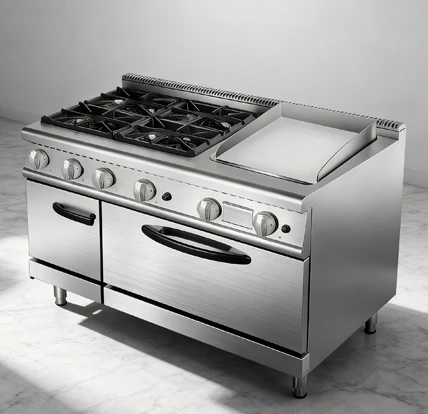
Certifications are the gate. For export, you need CE, REACH, RoHS, and ISO 9001 at minimum, covering safety, chemical compliance, hazardous substances, and quality management. Ask for the actual certificate files, not a logo on a brochure, because customs and buyers will verify. Dalin carries all four across the range line. The gas combi-range series lists the marks on each model.
| Mark | What it covers | Who asks for it |
|---|---|---|
| CE | Safety and health compliance for Europe | EU buyers and customs |
| REACH | Chemical substance safety | EU importers |
| RoHS | Restricts hazardous substances | EU and many resellers |
| ISO 9001 | Quality management system | Procurement and tenders |
2. Factory Capacity and Lead Time
A source manufacturer with its own plant controls quality and delivery better than a trader. Dalin runs a 50,000 m2 facility with 74 engineers and monthly output of 15,000 units, which supports large and seasonal orders. Ask for the plant size, headcount, and typical lead time, then match them to your forecast. Capacity gaps show up as missed delivery dates.
Capacity is not only about square meters. Ask how many units of your model they build per month, what their peak-season buffer is, and whether they hold steel inventory. A factory that stocks material ships more reliably when prices move or supply tightens.
3. OEM and ODM Support
If you sell under your own brand, confirm the manufacturer handles OEM (your logo and label) and ODM (your specs and design). Dalin supports both, from burner count to width and oven type. This lets you offer a distinct product without building a factory. Ask to see past OEM work, not just a promise. The configuration guide shows the module options you can spec.
| Service | What you get | When you need it |
|---|---|---|
| OEM | Your logo, label, packaging | Selling under your brand |
| ODM | Your specs and design input | A distinct product to your brief |
| CAD and 3D layout | Kitchen plan and render | Quoting and approvals |
4. Build Quality and Materials
Check the steel grade and thickness. Dalin uses 304 stainless steel, the food-grade standard, with plate thickness matched to volume. Ask for material certificates and a sample if you can. Thin steel warps and rusts; good steel lasts for years of daily heat. Quality here is cheaper than downtime later.
A practical check: ask for the body gauge in millimeters and the griddle plate thickness. For a busy line, look for at least a 1 mm body and a 19 mm or thicker griddle plate. The exact number matters less than the supplier being able to state it without hesitation.
5. Spare Parts and After-Sales
A range runs 12 hours a day, so parts will wear. Ask for a spare-parts list, lead time, and how long support lasts, often at least a year. Dalin provides parts support and the drawings to fit them. A supplier who cannot name parts lead time is a risk. Confirm this in writing before you pay.
Build your own spare-parts kit at launch: igniters, a burner set, valves, and gaskets sized to your model. A small upfront stock turns a two-week wait into a same-day fix and keeps the line running during peak.
6. Engineering and Design Support
The best manufacturers help you plan, not just sell. Dalin offers CAD and 3D kitchen layouts so your project gets approved faster and fits the line. Ask whether they review your floor plan and BTU load. This support shortens your own engineering work. The installation guide lists the site data to share.
7. References and Export Experience
Ask for references from buyers in your market, especially if you import to Europe, the Middle East, Southeast Asia, or the Americas. Export experience means they know the documents, packing, and compliance each region expects. Dalin has shipped to these regions for years. A supplier new to export may cost you in delays.
Beyond references, ask about packing for ocean freight and whether they handle documentation like commercial invoices and certificates of origin. These details decide whether your container clears smoothly or sits at the port.
8. Pricing and Payment Terms
Get a full quote: unit price, tooling for custom work, packing, and freight terms. Compare total landed cost, not just ex-works price. Reasonable deposits and milestones protect both sides. Very low prices often hide thin steel or weak support, so weigh the whole package. The gas vs electric guide helps if fuel choice affects your spec.
| Cost element | What to compare |
|---|---|
| Unit price | Ex-works vs delivered |
| Tooling | One-time charge for custom specs |
| Packing | Seaworthy crate or carton |
| Freight and duty | Landed cost to your door |
| Terms | Deposit plus balanced on documents |
9. Red Flags to Avoid
Avoid suppliers who dodge certificate requests, refuse a factory video call, or cannot name parts lead times. Watch for prices far below market with no clear reason. Press for references and a written after-sales policy. If something feels off in the early talks, it usually gets worse after deposit. The buyer’s guide frames these checks in the wider purchase.
| Red flag | What it may mean |
|---|---|
| Won’t share certificate files | Marks may not be valid |
| No factory video call | Possibly a trader or reseller |
| Cannot state parts lead time | Weak after-sales |
| Price far below market | Thin steel or cut support |
Frequently Asked Questions
Should I buy from a factory or a trading company?
A source manufacturer like Dalin controls quality and lead time directly. A trader adds a margin and less control. For volume, the factory is usually better.
What certifications do I need to import?
At minimum CE, REACH, RoHS, and ISO 9001. Request the files, not just a logo, because customs checks.
Can Dalin make our brand and specs?
Yes, through OEM and ODM, from logo and width to burner count and oven type, plus CAD and 3D layouts.
How long does support last?
Dalin provides parts support, typically at least a year, with drawings to fit them. Confirm the term in writing.
What capacity backs a large order?
Dalin runs a 50,000 m2 plant with 74 engineers and 15,000 units per month, which supports large and seasonal orders. Confirm current lead time against your forecast.
Request a Quote
Ready to choose your gas range manufacturer? Tell Dalin your volume, brand needs, and target market. We will share certificates, recommend a configuration, and provide a free 3D kitchen layout. Explore the gas combi-range series or contact our team for a quote and OEM inquiry.