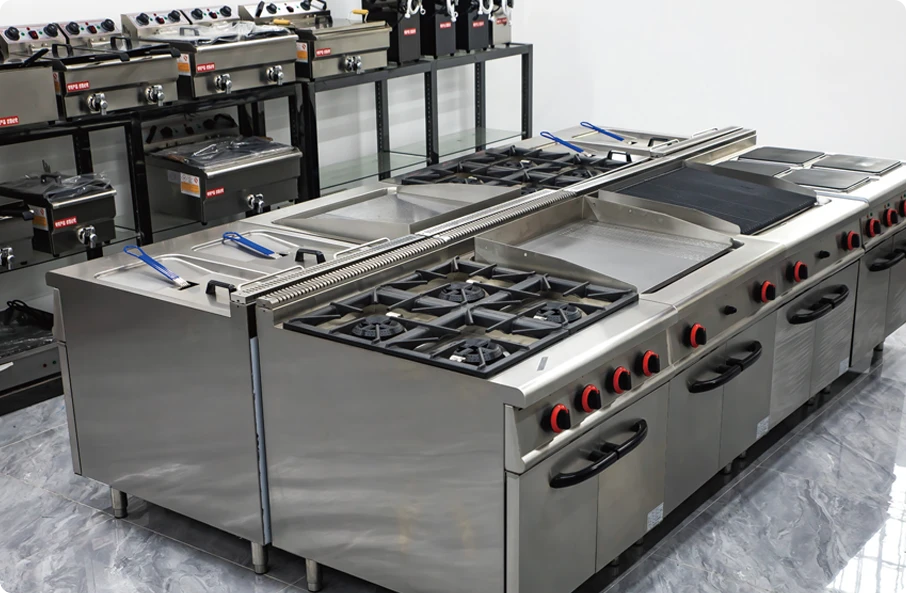
A modular gas range lets you build the cooking station your menu actually needs. Instead of buying separate appliances, you pick a body width and then choose which modules fill it: open burners, a flat-top griddle, a lava rock grill, an oven base, or a mix. Dalin’s DL-RS, DL-RA, and DL-BM series cover most configurations, with burner counts from 2 to 10. See the gas combi-range series for the full model list.
Table of Contents
- What Makes a Range Modular
- Open Burner Modules
- Flat-Top Griddle Modules
- Lava Rock Grill Modules
- Integrated Oven Base
- Common Module Combinations
- Burner Counts: 2, 4, 6, 10
- Matching Modules to Your Menu
- Material and Build Quality
1. What Makes a Range Modular
A modular range shares one steel body and one gas connection across several cooking zones. You decide how many of those zones are burners versus griddle or grill. The benefit is floor space and one install instead of three. The buyer’s guide explains where a modular range fits in a full kitchen plan.
Think of the body as a frame of fixed width, divided into bays. Each bay accepts one module type. A 6-bay body might be four open burners, one griddle, and one lava rock grill, with an oven below. Because the modules share one gas line and one hood, you cut install cost and footprint versus four standalone units.
2. Open Burner Modules
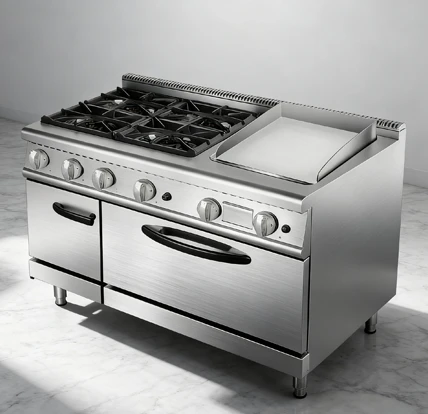
Open burners sit pots and pans directly over a flame. They give the fastest heat and the best control for boiling, sauteing, and sauce work. Output runs about 25,000 to 30,000 BTU per burner on Dalin units, which recovers temperature quickly after you add cold food. Count your peak-hour pans to size the burner count.
Open burners suit almost any hot line. If a dish needs a pot on a flame, this is the module. The trade-off is that spills fall into the burner box and need regular cleaning, so factor a daily wipe into your close-down routine.
3. Flat-Top Griddle Modules
A griddle is a solid steel plate that heats evenly across the whole surface, good for eggs, burgers, and stir-fry. It replaces two or three burners for those jobs and is easier to keep clean. Choose a thicker plate if you cook high volume, because it holds temperature better when loaded. Griddle and burner modules often sit side by side in the same body.
Griddle plates are usually 3/4 to 1 inch (about 19 to 25 mm) thick in commercial builds. Thicker plates cost more but swing less in temperature when you load cold food, which keeps cook times consistent during a rush.
4. Lava Rock Grill Modules
A lava rock grill cooks over radiant heat from stones heated by gas, giving meats a charred, smoky finish. It suits steakhouses and skewer menus. The rocks need periodic replacement as they absorb grease. If your menu is grill-forward, swap one or two burners for this module. The gas vs electric comparison covers why a gas flame suits grilling.
Radiant grills run hotter at the surface than open burners and give the sear that grilled menus depend on. The cost is more grease management: the rocks and the drip tray need attention, and the module is best placed where your team can reach it for cleaning.
5. Integrated Oven Base
An oven base turns the range into a full station: roasting, baking, and braising below the cooktop. Dalin offers convection ovens in the base for even heat. This is the usual choice for hotels and central kitchens that need both top and bottom cooking in one footprint, and it saves the floor space a separate oven would take.
A convection oven base typically adds 25,000 to 40,000 BTU to the total load, so it affects your gas line and hood sizing. In return you get baking and roasting right under the line, which is why it is common in hotels and central kitchens.
6. Common Module Combinations
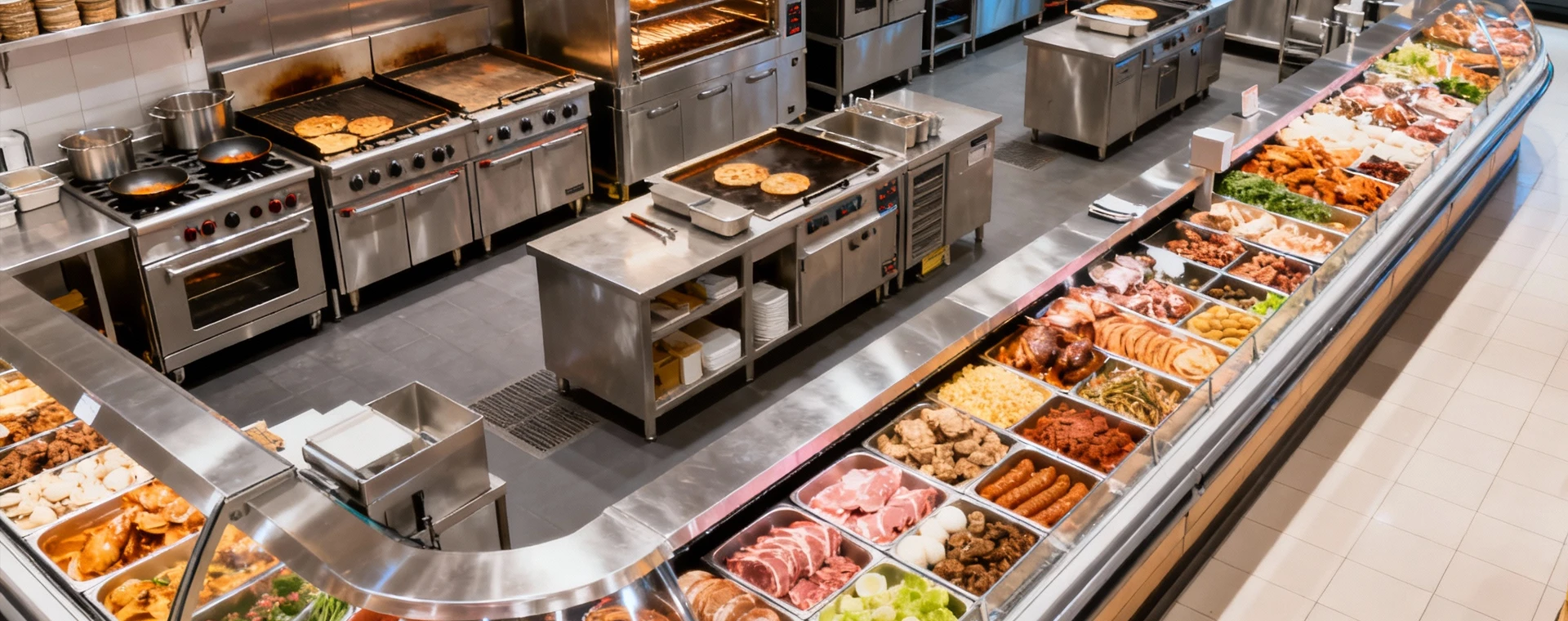
A cafe might run 4 burners with a half-size griddle. A hotel kitchen often uses 6 to 10 burners with a full griddle and an oven base. A grill house leans on lava rock plus a few burners. There is no single right mix; it follows your menu. Sketch your peak service first, then fill the body.
| Module | Typical output | Best for | Footprint per bay |
|---|---|---|---|
| Open burner | 25,000 to 30,000 BTU | Boiling, saute, sauce | 1 bay |
| Flat-top griddle | Even plate heat | Eggs, burgers, stir-fry | 1 to 2 bays |
| Lava rock grill | High radiant sear | Steak, skewers | 1 to 2 bays |
| Oven base | 25,000 to 40,000 BTU | Bake, roast, braise | Full width below |
7. Burner Counts: 2, 4, 6, 10
Smaller sites start at 2 or 4 burners; high-volume sites go to 6 or 10. More burners mean more gas load and a bigger hood, so size to your real peak, not your wish list. A 100-seat restaurant typically needs 6 burners plus griddle and oven. The installation guide shows how burner count drives gas line and ventilation size.
| Burners | Good for | Approx. total BTU (burners only) | Hood and gas note |
|---|---|---|---|
| 2 | Cafes, small prep | 50,000 to 60,000 | Smallest utility need |
| 4 | Small restaurants | 100,000 to 120,000 | Standard single circuit |
| 6 | 100-seat restaurants | 150,000 to 180,000 | Size line and hood up |
| 10 | High-volume, hotels | 250,000 to 300,000 | Dedicated large supply |
8. Matching Modules to Your Menu
If you boil and saute, weight burners. If you plate breakfast or burgers, weight griddle. If you char meats, weight the lava rock grill. Most kitchens blend all three, and that is exactly what a modular body allows. Write down your top ten dishes and map each to a module before you order.
| Your top dishes | Lead module | Support module |
|---|---|---|
| Pasta, soups, saute | Open burners | Griddle (garnish) |
| Burgers, breakfast | Griddle | Open burners |
| Steak, skewers | Lava rock grill | Open burners |
| Roast, bake, braise | Oven base | Open burners |
9. Material and Build Quality
Dalin builds these ranges in 304 stainless steel, the food-grade standard that resists rust and wipes clean. Check the steel thickness on the body and the griddle plate, because thin steel warps under daily heat. Quality here pays back over years of service. The manufacturer guide lists the build questions to ask before you buy.
A quick quality check before you order: ask for the body gauge (thicker lasts longer), the griddle plate thickness, and whether the oven lining is stainless. These details separate a unit that looks the same in a photo but behaves very differently after a year of service.
Frequently Asked Questions
Can I change the module mix later?
The body is built to a fixed module layout, so changes after manufacture are limited. Plan your mix from your menu before ordering; OEM options let you spec it upfront.
What burner count do most restaurants need?
A 100-seat restaurant usually needs 6 burners plus a griddle and oven. Smaller cafes start at 2 to 4. Size to peak service.
Do modular ranges save space?
Yes. One body replaces separate burners, griddle, grill, and oven, cutting floor space and needing only one gas connection.
Are DL-RS, DL-RA, and DL-BM different module types?
They are Dalin series covering different widths and module arrangements. Share your menu with the team and they will point to the right series.
How much gas does a full modular range use?
It scales with modules: a 6-burner unit with griddle and oven can pass 150,000 BTU or more. Add each module’s rating to size your line and hood.
Request a Quote
Ready to spec your modular gas range? Tell Dalin your top dishes, covers per day, and kitchen width. We will recommend a module layout, share the certificate files, and provide a free 3D kitchen layout. Explore the gas combi-range series or contact our team for a quote and OEM inquiry.