Table of Contents
A commercial gas range is a heavy-duty cooking station that uses natural gas or LPG to power open burners, griddles, broilers, and ovens in a single footprint. It is the workhorse of restaurants, hotels, and institutional kitchens because gas delivers instant, precise heat at a lower running cost than electricity. This guide explains what a commercial gas range is, the main types, how to size and configure one, the installation basics, and how to choose a reliable manufacturer.
- What Is a Commercial Gas Range?
- Main Types of Commercial Gas Ranges
- Gas vs Electric: Which Should You Pick?
- How to Configure a Modular Gas Range
- How to Size a Gas Range for Your Kitchen
- Key Specs and Materials to Check
- Installation and Ventilation Basics
- Certifications for Export Markets
- How to Choose a Gas Range Manufacturer
1. What Is a Commercial Gas Range?
A commercial gas range (also called a gas combi-range) is a freestanding cooking appliance built for non-stop foodservice use. Unlike a home stove, it uses thicker steel, higher burner output, and reinforced frames so it can run for 12 or more hours a day. Most models combine several cooking functions: open burners for pots and pans, a flat-top griddle for eggs and burgers, a broiler or lava rock grill for meats, and an oven base for roasting or baking.
The word range simply means a complete cooking station. In a busy kitchen, one range can replace three or four separate appliances, which saves floor space and speeds up service. Dalin builds modular gas ranges in 304 stainless steel with burner counts from 2 to 10, so you can match the unit to your menu and volume.
2. Main Types of Commercial Gas Ranges
Not all ranges are the same. The main types differ by which cooking modules they carry and how they are arranged. You can compare them on our commercial cooking equipment overview, but the short version is below.
| Type | Best for | Key feature |
|---|---|---|
| Open-burner range | Boiling, sauteing, sauce | Round burners, instant flame control |
| Griddle range | Breakfast, burgers, stir-fry | Flat steel plate, even contact heat |
| Broiler or grill range | Steaks, skewers, char | Lava rock or radiant broiler |
| Oven-base range | Roasting, baking, braising | Integrated gas convection oven |
| Modular combi-range | Mixed menus, tight space | Mix burners, griddle, grill, oven |
Most buyers today choose a modular combi-range because it adapts to the menu. You decide how many open burners you need, then add a griddle section, a grill section, or an oven base to fill the same body.
3. Gas vs Electric: Which Should You Pick?
Gas is usually the first choice for high-volume kitchens because it heats faster and costs less to run. Electric ranges are easier to install where gas lines are not available. We break down cost, heat control, and running cost in our gas vs electric commercial range comparison so you can decide with numbers, not guesswork.
For most restaurants, the deciding factor is total cost of ownership. Gas gives lower energy bills and faster recovery between batches, which matters when you serve hundreds of covers a day.
4. How to Configure a Modular Gas Range
A modular gas range lets you build the cooking line you actually need. Start with the number of open burners (2, 4, 6, or 10), then replace some of them with a flat-top griddle, a lava rock grill, or an integrated oven. Our modular gas range configuration guide walks through common layouts for different menus.
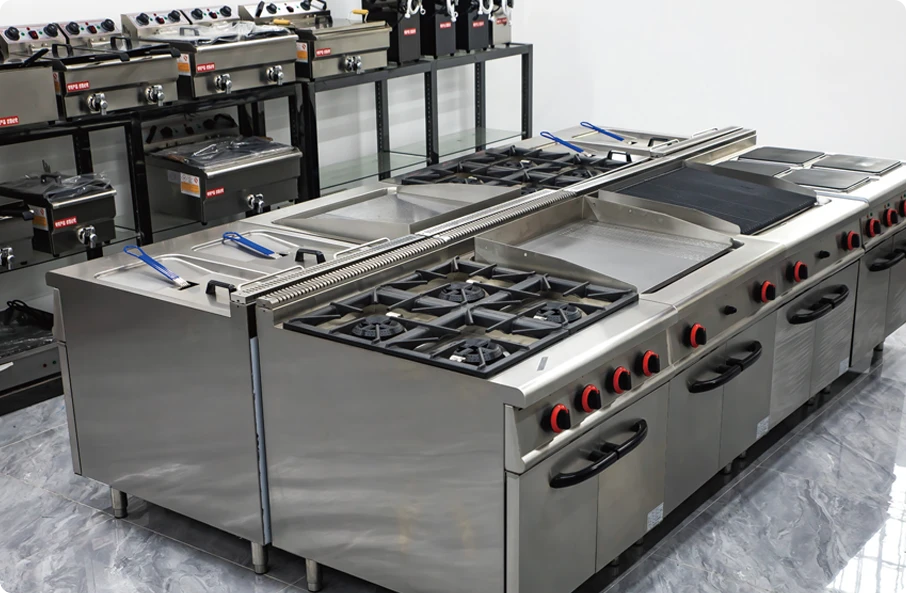
Dalin’s DL-RS, DL-RA, and DL-BM series cover most configurations. A 4-burner model with a half-size griddle suits a cafe; a 6 to 10 burner unit with oven base suits a hotel or central kitchen. Because the modules share one body, you save counter space and need only one gas connection.
5. How to Size a Gas Range for Your Kitchen
Sizing is about covers per day, not kitchen square metres. A small cafe doing 50 covers needs 2 to 4 burners; a 200-seat restaurant needs 6 to 10 burners plus griddle and oven. Count your peak-hour pans, then add one burner of buffer. If you run a grill-heavy menu, swap burners for a griddle or lava rock section.
Also check the body width. Standard widths are 600 mm, 700 mm, and 900 mm. Match the width to your existing line so the range sits flush and meets clearance rules described in the installation section.
6. Key Specs and Materials to Check
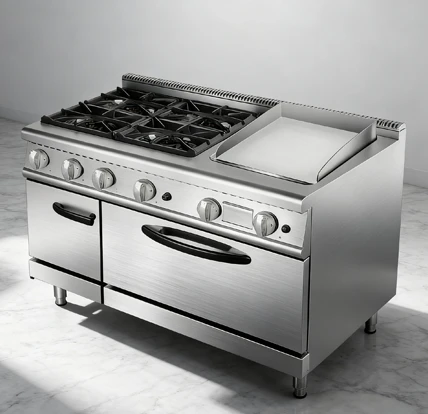
Look at four specs before you buy: burner output (measured in BTU or kW), number of burners, body material, and oven type. Dalin ranges use 304 stainless steel, the food-grade standard that resists rust and is easy to clean. Burner output decides how fast water boils and how evenly a griddle cooks.
A higher BTU burner recovers temperature faster after you add cold food, which keeps a busy line moving. For most menus, 25,000 to 30,000 BTU per open burner is a solid baseline; griddles need even heat across the whole plate, so check the plate thickness.
7. Installation and Ventilation Basics
Gas ranges need a certified gas line, proper ventilation, and clearance from combustible surfaces. The exact gas line size and hood requirements depend on your BTU load and local code. Our commercial gas range installation guide lists ventilation, gas line, and clearance checks every buyer and engineer should confirm before delivery.
Plan the install early. A range that arrives before the gas line and hood are ready will sit unused. Share your floor plan and menu volume with the supplier so they can advise on BTU load and placement.
8. Certifications for Export Markets
If you import or resell across borders, certifications are not optional. Dalin ranges carry CE, REACH, RoHS, and ISO 9001, which cover electrical safety, chemical compliance, hazardous-substance limits, and quality management. These marks are the baseline for entering Europe, the Middle East, Southeast Asia, and the Americas.
Always ask the manufacturer for the actual certificate files, not just a logo on the brochure. Customs and buyers will request them, and having them ready shortens the import process.
9. How to Choose a Gas Range Manufacturer
The right manufacturer affects price, lead time, and after-sales for years. Beyond certifications, check factory capacity, OEM and ODM support, and spare-parts policy. Our guide to choosing a gas range manufacturer covers the questions to ask before you sign.
Dalin is a source manufacturer with an 18-plus year track record, a 50,000 m2 plant, 74 engineers, and monthly output of 15,000 units. We support OEM and ODM (your logo, specs, and finish) and provide CAD and 3D kitchen layouts so your project gets approved faster.
Frequently Asked Questions
What size gas range do I need for a 100-seat restaurant?
A 100-seat restaurant typically needs 6 open burners plus a griddle section and an oven base. Count your peak-hour pans and add one burner of buffer; if you serve breakfast or burgers, allocate more griddle space.
Is a modular gas range better than separate units?
For most kitchens, yes. A modular combi-range puts burners, griddle, grill, and oven in one body, saving floor space and one gas connection. Separate units cost more to install and take more room.
Which certifications do I need to import gas ranges to Europe?
At minimum, CE marking plus REACH and RoHS compliance, backed by ISO 9001 for quality management. Request the certificate files from the supplier before import.
Can Dalin customize the range with our brand and specs?
Yes. Dalin offers OEM and ODM: your logo, colour, burner count, width, and oven type can be customized, and the team provides CAD and 3D kitchen layouts for project approval.
Request a Quote
Ready to specify your commercial gas range? Tell Dalin your menu, covers per day, and kitchen dimensions, and we will recommend a modular configuration, share the certificate files, and provide a free 3D kitchen layout. Explore the gas combi-range series or contact our team for a quote and OEM inquiry.