To maintain consistent food quality across multiple locations, a central kitchen requires heavy-duty commercial cooking equipment engineered for large-volume batch production, continuous operation, and standardized workflows. Selecting unsuitable equipment inevitably leads to severe production delays, inflated labor costs, and compromised food safety. As a manufacturer with over 18 years of experience in the commercial kitchen industry, Guangdong Dalin Kitchen Equipment provides this technical guide to help project managers, catering operators, and food production companies calculate production capacity, optimize workflow layouts, and configure the right central kitchen equipment for maximum operational efficiency and long-term ROI.
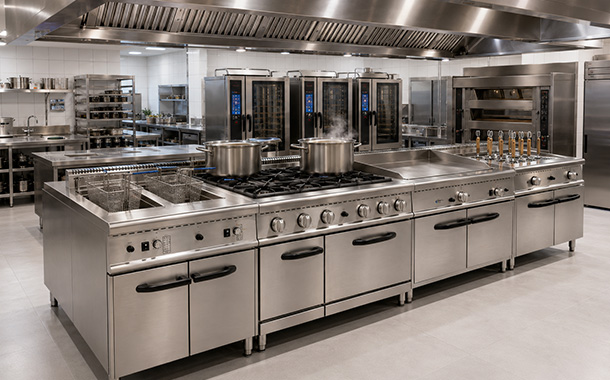
Table of Contents
- The Core Difference: Central Kitchen vs. Standard Restaurant Equipment
- Evaluating High-Capacity Cooking Performance for Batch Production
- Designing Workflow-Oriented Equipment Configurations
- Heating Efficiency and Thermal Recovery in Mass Production
- Maximizing Labor Efficiency Through Automated Cooking Solutions
- Heavy-Duty Durability and Hygiene Standards
- Application Scenarios: Sizing Equipment for Specific Production Models
- Decision Framework: Selecting the Right Central Kitchen Equipment
- Conclusion
1. The Core Difference: Central Kitchen vs. Standard Restaurant Equipment
Central kitchen equipment prioritizes massive batch capacity, continuous operation, and automated temperature control, because these facilities must manufacture standardized output for distribution rather than individual, high-flexibility a la carte orders.
A central kitchen does not function like a traditional restaurant kitchen; it operates as an industrial food manufacturing facility. While a standard restaurant kitchen is designed around order-by-order flexibility, a central kitchen is designed strictly around workflow efficiency and production volume.
The equipment selection process must shift from focusing on individual cooking tasks to evaluating the entire production lifecycle: raw material preparation, batch cooking, temperature control, bulk food holding, and final packaging. Attempting to outfit a central kitchen with standard restaurant-grade equipment will result in immediate production bottlenecks, as light-duty burners and small-capacity pans simply cannot meet the throughput required to supply dozens of downstream locations or large-scale institutional contracts.
2. Evaluating High-Capacity Cooking Performance for Batch Production
Equipment capacity must be calculated based on maximum daily meal output and target batch sizes to minimize the number of production cycles and ensure absolute recipe consistency.
The most critical factor for central kitchen equipment selection is its high-capacity cooking performance. Central kitchens must prepare massive quantities in the fewest possible production cycles. By reducing the number of batches, operators minimize the risk of human error and ensure that the first liter of sauce tastes exactly like the thousandth.
When determining capacity, buyers must evaluate two primary heavy-duty solutions:
- Commercial Cooking Kettles: A commercial cooking kettle is strongly recommended when producing large volumes of soups, sauces, stews, and other liquid-based foods. These units (often ranging from 100L to over 500L) provide consistent jacketed heating, eliminating hot spots and preventing delicate sauces from scorching. They drastically reduce manual labor by replacing dozens of standard stockpots.
- Commercial Tilting Skillets: A commercial tilting skillet (or braising pan) is more suitable when the menu requires bulk stir-frying, braising, or sautéing. These highly versatile units feature wide, flat cooking surfaces and mechanical tilting mechanisms, allowing operators to easily transfer massive volumes of heavy, solid foods (like braised meats or fried rice) directly into distribution containers without manual scooping.
3. Designing Workflow-Oriented Equipment Configurations
A highly efficient central kitchen requires an integrated equipment configuration that logically connects raw material preparation, bulk cooking, and packaging zones to eliminate unnecessary manual transfer and cross-contamination risks.
Central kitchens rarely operate efficiently using standalone machines scattered across a room. They require a systemic, workflow-oriented layout where equipment combinations facilitate a unidirectional flow of food.
A standard high-efficiency layout integrates:
- The Bulk Cooking Section: The core of the facility, housing massive kettles and tilting skillets for the primary heavy lifting.
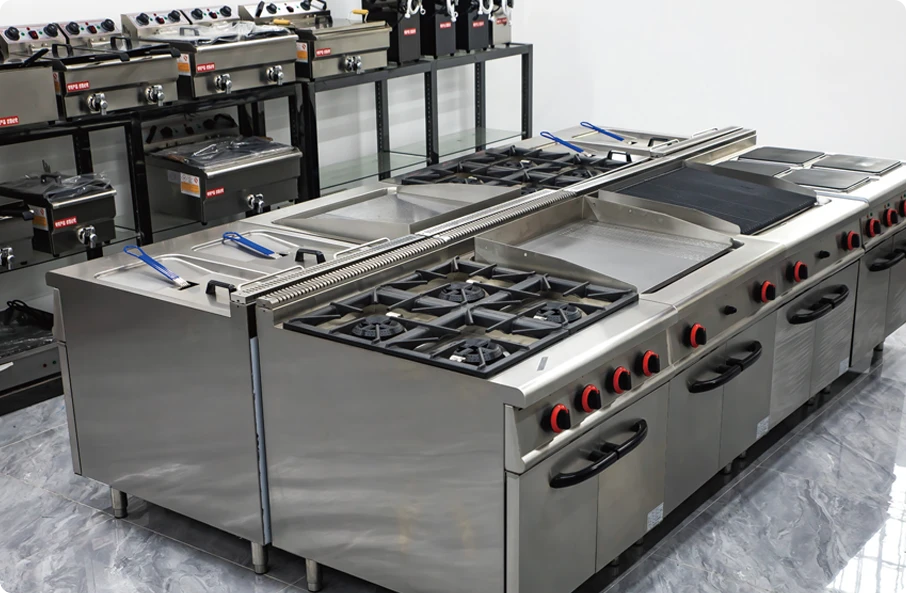
- The Specialty/Finishing Section: Where secondary processes occur. For example, a heavy-duty commercial gas range or a massive commercial flat top griddle may be installed to sear specific proteins before they are transferred into a braising pan. A commercial rotisserie oven might be deployed in a dedicated zone for large-scale poultry processing.
- Supporting Zones: Preparation stations, blast chilling (temperature control), and packaging must immediately follow the cooking line. If hot food must be transported across the kitchen to be packaged, the layout is flawed, increasing both labor costs and food safety risks.
4. Heating Efficiency and Thermal Recovery in Mass Production
Large-scale food production demands high-efficiency heating systems with rapid thermal recovery to ensure uniform cooking temperatures across massive batches, directly impacting both food safety and energy costs.
In a central kitchen operating 12 to 24 hours a day, heating performance dictates production speed.
When a kitchen staff drops 100 kilograms of raw, cold ingredients into a skillet, the equipment experiences a massive thermal shock. Standard equipment will suffer a severe temperature drop and may take 20 minutes to recover, essentially boiling the food rather than searing or frying it.
Heavy-duty central kitchen equipment utilizes advanced burner configurations, thicker cooking plates, and higher BTU/kW ratings to ensure rapid thermal recovery. Furthermore, efficient insulation within these units ensures that thermal energy is directed into the food rather than escaping into the kitchen. This precision temperature control prevents localized burning, guarantees cooking uniformity, and significantly reduces the facility’s monthly energy expenditures.
5. Maximizing Labor Efficiency Through Automated Cooking Solutions
Integrating automatic cooking machines and semi-automated mechanical systems is critical for central kitchens because it reduces repetitive manual labor, lowers operational costs, and guarantees precise recipe standardization.
Labor availability and cost are two of the biggest challenges facing modern foodservice organizations. Central kitchens solve this by replacing manual effort with mechanical precision.
An automatic cooking machine (such as an automated programmable stir-fryer) is highly recommended for restaurant chains and ready-to-eat food manufacturers. These machines can be programmed with precise recipes—controlling exact temperatures, rotation speeds, and cooking times. This automation ensures that every batch is perfectly consistent, regardless of which operator is running the machine. Additionally, features like automated water filling, mechanical tilting for food transfer, and integrated cleaning nozzles dramatically reduce the physical strain on kitchen staff, allowing a single operator to manage multiple massive cooking stations simultaneously.
6. Heavy-Duty Durability and Hygiene Standards
Central kitchen equipment must feature high-grade stainless steel construction, corrosion resistance, and easy-to-clean sanitary designs to withstand intensive continuous use and comply with strict food safety regulations.
Because central kitchen equipment experiences intensive, industrial-level use, durability is a non-negotiable purchasing factor. Equipment failure in a central kitchen does not just affect one dining room; it can disrupt supply chains for dozens of downstream restaurants or institutions.
Key Manufacturing Requirements:
- Material Integrity: Must be constructed from food-grade stainless steel (such as 304 or 316 grade) to resist corrosion from acidic ingredients, heavy salts, and continuous high-temperature exposure.
- Sanitary Design: The equipment must feature seamless welding, coved corners, and IPX4 (or higher) water resistance. Central kitchens undergo rigorous chemical washdowns daily; equipment must be designed so that grease and bacteria cannot hide in crevices, and electrical components must be fully protected against high-pressure cleaning.
- Structural Robustness: Frames must be built to support dynamic loads (such as hundreds of liters of boiling liquid shifting during a tilt) without warping or mechanical failure over a long service life.
7. Application Scenarios: Sizing Equipment for Specific Production Models
Central kitchen equipment selection must strictly align with the business model: restaurant chains require highly standardized batch equipment, while catering companies demand versatile, multi-purpose cooking lines.
Different central kitchen operations require different equipment strategies. Dalin recommends configuring your procurement based on your specific output requirements:
Restaurant Chain Central Kitchens
Chains use central kitchens to prepare standardized bases (soups, sauces, marinades) for nationwide distribution.
- Equipment Focus: Reliability and exact recipe replication. High-capacity commercial cooking kettles and automatic cooking machines are prioritized to ensure uniform taste across all franchise locations.
Catering Company Central Kitchens
Caterers handle large, varied events with short production schedules and constantly changing menus.
- Equipment Focus: Flexibility. Multi-purpose commercial tilting skillets and heavy-duty modular cooking lines are favored because they can switch from braising meats to stir-frying vegetables within the same shift.
School and Institutional Meal Production
Hospitals and schools require massive daily outputs of standardized, nutritionally controlled meals.
- Equipment Focus: Sheer volume and safety. Massive kettles for bulk soups and rice cooking systems dominate the workflow to feed thousands of people simultaneously under strict hygiene controls.
Ready-to-Eat Food Production
Companies producing packaged meals for retail require industrial-level consistency.
- Equipment Focus: Automation and scalable systems. Programmable industrial cooking kettles and automated processing lines are essential to maintain shelf-life stability and precise portion control.
8. Decision Framework: Selecting the Right Central Kitchen Equipment
A customized commercial kitchen equipment configuration is recommended when a facility has unique production workflows or specialized recipes, whereas standard heavy-duty units are sufficient for basic, large-volume boiling and frying.
To help B2B buyers navigate the procurement process, use the following technical evaluation matrix to match equipment types to your specific central kitchen requirements:
| Equipment Solution | Primary Technical Function | Best Application Scenarios | B2B Procurement Advantage |
| Commercial Cooking Kettle | Jacketed, uniform bulk liquid heating | Soups, sauces, gravies, stews, boiling pasta | Maximizes volume-to-floor-space ratio; prevents scorching without manual stirring. |
| Commercial Tilting Skillet | Multi-purpose wide-surface cooking | Braising meats, bulk stir-frying, sautéing | Mechanical tilting heavily reduces labor during food transfer; highly versatile. |
| Automatic Cooking Machine | Programmable, automated agitation | Ready-to-eat meals, standardized chain recipes | Eliminates human error; guarantees 100% recipe consistency; lowers labor costs. |
| Heavy-Duty Gas Range / Griddle | Continuous high-BTU pan/surface cooking | Searing proteins prior to batching, specialty prep | Provides necessary high-heat flexibility for complex, multi-step production recipes. |
Note: Rather than sourcing individual machines from multiple vendors, project managers should seek manufacturers capable of providing complete kitchen configuration support to ensure all units integrate seamlessly into a single, highly efficient production line.
9. Conclusion
Equipping a central kitchen is a complex industrial engineering task that requires a deep understanding of production volume, workflow dynamics, and mechanical reliability. Procurement teams must look past the initial purchase price and evaluate how the equipment impacts long-term operating costs, labor efficiency, and consistent food quality.
Whether your facility requires massive commercial cooking kettles to supply a hospital network, or automated cooking machines to standardize a restaurant chain’s signature sauce, the equipment must be designed for continuous, heavy-duty operation. By selecting the right high-capacity equipment and designing a logical, workflow-oriented layout, central kitchens can eliminate production bottlenecks, reduce manual labor, and maintain the highest standards of food safety.
Looking for Reliable Central Kitchen Solutions?
With over 18 years of manufacturing expertise and a 50,000㎡ production facility, Guangdong Dalin Kitchen Equipment Co., Ltd. provides heavy-duty commercial cooking equipment and comprehensive OEM/ODM solutions for global central kitchen projects. Our products comply with CE, RoHS, and ISO 9001 standards, ensuring reliable performance in the most demanding food production environments. Contact our engineering team today for customized equipment recommendations, production-oriented layout advice, and detailed project quotations.
Frequently Asked Questions (FAQs)
1. What is the difference between a central kitchen and a commercial restaurant kitchen?
A standard commercial kitchen cooks individual meals on demand (a la carte) with high menu flexibility. A central kitchen operates like a food factory, focusing on large-volume batch production, recipe standardization, and centralized distribution to multiple remote locations.
2. Why should a central kitchen use a commercial tilting skillet instead of standard large pots?
A commercial tilting skillet provides a massive, uniformly heated surface area ideal for bulk cooking. More importantly, it features a mechanical tilting system that allows operators to easily and safely pour hundreds of pounds of hot food into transport containers, which is impossible with standard stockpots.
3. How does automation benefit large-scale food production?
Automated equipment, like programmable stir-fry machines, removes human error from the cooking process. It ensures exact temperatures, cooking times, and agitation speeds are applied to every batch, guaranteeing uniform taste while allowing a single worker to operate multiple machines simultaneously.
4. What size commercial cooking kettle do I need for my facility?
Kettle sizing depends entirely on your daily meal output and batch frequency. A small catering prep kitchen might use an 80L or 100L kettle, while a massive institutional central kitchen may require multiple 300L or 500L kettles to meet peak production periods efficiently.
5. How important is customized equipment configuration for a central kitchen?
Highly important. Central kitchens rarely use purely standard layouts. Customizing the dimensions, burner configurations, and workflow placement ensures the equipment perfectly matches the facility’s physical footprint and specific food production processes, thereby eliminating cross-traffic and improving efficiency.
6. Can Dalin support complete central kitchen equipment projects?
Yes. Dalin does not just sell individual machines; we provide comprehensive project support. We offer professional kitchen configuration advice, equipment selection recommendations, and customized manufacturing to ensure your central kitchen achieves maximum production efficiency.