Selecting the right size commercial kitchen equipment requires balancing daily food production volume, peak-hour demand, available kitchen footprint, and menu complexity. Undersized equipment creates operational bottlenecks during rush hours, while oversized units inflate energy consumption and waste valuable workspace. As a manufacturer with over 18 years of experience in commercial kitchen solutions, Guangdong Dalin Kitchen Equipment provides this technical guide to help foodservice operators, project managers, and kitchen designers calculate capacity requirements and configure the optimal cooking layout for maximum ROI.
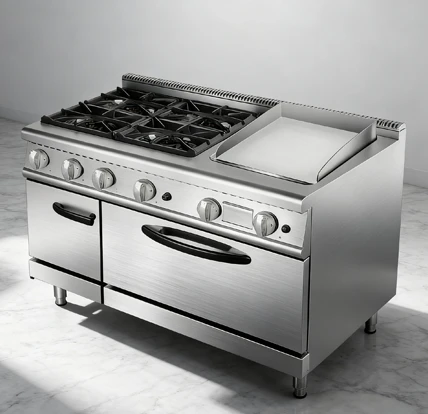
Table of Contents
- Why Correct Commercial Kitchen Equipment Sizing Matters
- Step 1: Calculating Food Production Volume and Peak-Hour Demand
- Step 2: Evaluating Kitchen Space and Layout Constraints
- Step 3: Matching Heating Power to Equipment Dimensions
- Application Scenarios: Sizing Equipment for Different Foodservice Sectors
- Common Equipment Sizing Mistakes and Procurement Risks
- Decision Framework: Standard vs. Customized Equipment Configurations
- Conclusion
1. Why Correct Commercial Kitchen Equipment Sizing Matters
Correctly sizing commercial kitchen equipment prevents production bottlenecks during peak hours, maximizes expensive floor space utilization, and optimizes both energy consumption and long-term operating costs.
Choosing the right size of commercial kitchen equipment is not simply about selecting the largest available model to be “safe.” In modern commercial kitchens, floor space is a premium asset. Every square meter dedicated to oversized equipment is a square meter taken away from prep areas, cold storage, or the dining room.
From an engineering and operational perspective, mismatched equipment sizing creates cascading failures:
- Oversized Equipment: Leads to excessive energy consumption, higher initial capital investment, and increased HVAC strain. A massive griddle operating at 30% capacity wastes expensive gas or electricity and dumps unnecessary ambient heat into the kitchen.
- Undersized Equipment: Fails to keep up with peak-hour turnover. When a cooking surface is overloaded with cold food, the temperature drops rapidly. If the equipment is too small to recover quickly, food quality suffers (e.g., boiled steaks instead of seared), service slows down, and customer satisfaction drops.
Professional commercial cooking equipment selection focuses on achieving a synchronized workflow where equipment capacity precisely matches the rhythm of the business.
2. Step 1: Calculating Food Production Volume and Peak-Hour Demand
Equipment capacity must be calculated based on maximum peak-hour meal demand and batch size requirements, rather than simply dividing average daily volume by operating hours.
When determining what size commercial cooking equipment your business needs, the first technical step is capacity calculation. A restaurant serving 500 meals a day might serve 300 of those meals within a tight two-hour dinner rush. Equipment must be sized to handle that two-hour spike.
Key calculations for equipment sizing:
- Surface Area Capacity: For equipment like a commercial flat top griddle, calculate the size of your core menu items (e.g., a 4-inch burger patty). Factor in the space needed between items for flipping. A 24-inch griddle may hold 20 patties, while a 36-inch unit can hold 35. If peak demand requires 100 patties per hour and cooking takes 10 minutes, a 24-inch griddle will create a severe bottleneck.
- Batch Volume: For liquid or bulk items, volume dictates size. Institutional kitchens must calculate exactly how many liters of soup or sauce are required per service to select the correct commercial cooking kettle capacity (e.g., 50L vs. 150L).
- Burner Count: A commercial gas range should be sized based on the number of pans a chef needs to manage simultaneously during a rush. A 4-burner range is sufficient for low-volume sauté stations, but high-volume a la carte menus often require 6-burner or 8-burner configurations.
3. Step 2: Evaluating Kitchen Space and Layout Constraints
Commercial cooking equipment dimensions must strictly align with available hood clearance, operational depth, and required aisle space to ensure workflow efficiency and safety compliance.
How to choose commercial kitchen equipment size for a restaurant depends heavily on the physical constraints of the building. You cannot select heavy duty commercial kitchen equipment without first evaluating the spatial footprint.
Critical Dimensional Factors:
- Linear Width vs. Depth: While many buyers focus entirely on equipment width (e.g., a 36-inch vs. 48-inch range), depth is equally critical. Equipment that protrudes too far into the cooking aisle disrupts the flow of kitchen staff and increases the risk of accidents.
- Ventilation Hood Constraints: Equipment size is fundamentally limited by the exhaust hood. Health and safety regulations generally require the hood to extend at least 6 inches beyond the edge of the cooking equipment. An oversized oven under an undersized hood violates fire codes and leads to grease accumulation.
- Equipment Formats:
- Countertop Units: Recommended when linear floor space is unavailable. They allow operators to utilize existing refrigeration or prep tables as bases.
- Floor-Standing Models: Recommended for high-capacity continuous cooking where structural durability is paramount.
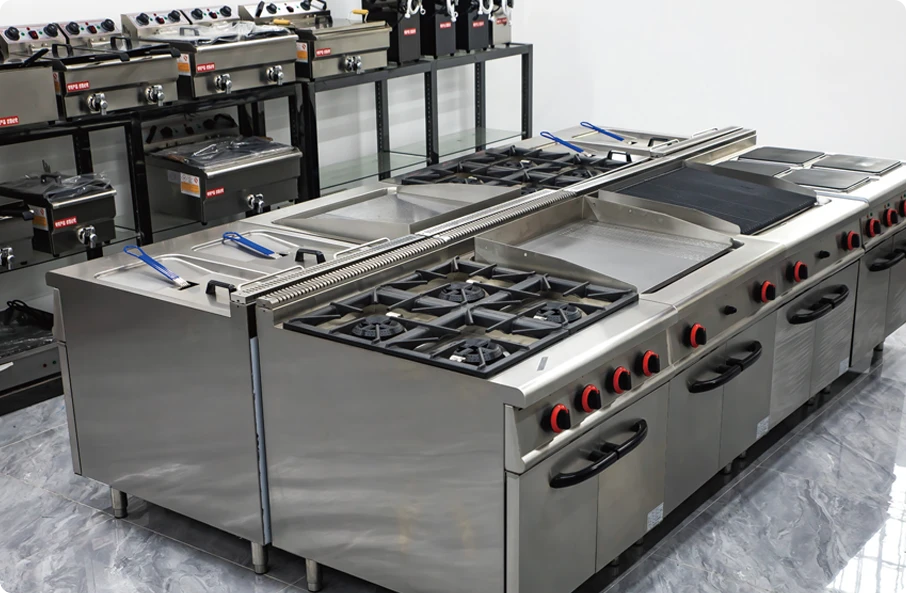
- Modular Cooking Lines: Ideal for optimizing specific spatial constraints, allowing different cooking modules to interlock seamlessly.
4. Step 3: Matching Heating Power to Equipment Dimensions
A larger equipment footprint must be supported by proportional heating power (BTU or kW) and appropriate material thickness to ensure rapid temperature recovery after heavy food loading.
A common mistake in commercial kitchen equipment sizing is assuming that larger physical dimensions automatically equal higher production capacity. If a large cooking surface lacks the underlying heating power, it becomes a liability.
When evaluating restaurant kitchen equipment capacity, you must cross-reference physical dimensions with thermal performance:
- Recovery Speed: When 20 frozen chicken breasts are dropped onto a large griddle or into a fryer, the temperature crashes. The equipment’s power rating determines how fast it returns to the target cooking temperature.
- Material Thickness: On larger units, heat distribution becomes a challenge. For example, a 48-inch commercial flat top griddle requires a thicker steel plate (typically 3/4-inch to 1-inch) than a 24-inch model to prevent warping and ensure uniform heat distribution across the expanded surface area.
- Utility Infrastructure: Upgrading to a larger size often requires utility upgrades. A high-capacity commercial range may require a larger gas line diameter to deliver sufficient BTUs, or an electrical panel upgrade to support higher commercial cooking equipment dimensions and power loads.
5. Application Scenarios: Sizing Equipment for Different Foodservice Sectors
Equipment sizing varies drastically by application: restaurants require flexible, multi-functional units, while hotels and commissaries depend on specialized, high-capacity batch equipment.
Choosing the best size commercial cooking equipment for hotels and restaurants requires analyzing the specific operational model. Different foodservice environments require different sizing strategies.
Small to Medium Restaurants
Restaurants typically prioritize menu flexibility and space-saving designs. A compact footprint that can handle diverse tasks is essential.
- Typical Selection: A commercial range with griddle is highly recommended. By combining open burners for sautéing and a built-in griddle for searing within a single 48-inch or 60-inch footprint, restaurants maximize output per square meter without purchasing separate units.
Hotels and Banquet Facilities
Hotel kitchens face dual challenges: standard a la carte dining and high-volume banquet service. They require heavy duty commercial kitchen equipment capable of continuous operation and rapid mass production.
- Typical Selection: Heavy-duty modular cooking lines. A commercial rotisserie oven might be sized for high-volume buffet prep, while the main hot line features multi-zone heavy-duty ranges. Sizing here prioritizes reliability and massive peak-hour throughput.
Institutional Kitchens and Central Commissaries
Schools, corporate cafeterias, and catering businesses focus on standardized, large-batch cooking with minimal menu variation during service.
- Typical Selection: Rather than multiple standard ranges, these facilities require a commercial tilting skillet (braising pan) sized between 80L to 150L, and high-capacity commercial cooking kettles. These oversized units reduce labor costs by allowing one operator to produce hundreds of portions simultaneously.
6. Common Equipment Sizing Mistakes and Procurement Risks
Procurement failures usually occur when buyers select equipment based solely on upfront costs or physical dimensions without evaluating menu expansion, workflow ergonomics, and utility constraints.
Through 18+ years of providing commercial kitchen solutions, Dalin has identified several critical mistakes buyers make regarding commercial cooking equipment selection:
- Ignoring the “Doorway” Problem: Purchasing large equipment without measuring the delivery path. If a heavy-duty oven cannot fit through the kitchen doors or service elevator, installation becomes a costly nightmare.
- Failing to Plan for Menu Expansion: Sizing equipment strictly for today’s menu limits future growth. If a business plans to add breakfast service in the next year, sizing up the griddle during initial procurement is cheaper than replacing it later.
- Mismatched Component Sizing: Buying a massive gas range but pairing it with undersized refrigeration at the chef’s base. The cooking capacity will outpace the ingredient storage, forcing chefs to leave the station frequently and destroying workflow efficiency.
7. Decision Framework: Standard vs. Customized Equipment Configurations
Standard equipment sizes are recommended for traditional menus with predictable volumes, while customized configurations are required to resolve specific spatial constraints and heavy-duty workflow bottlenecks.
To help professional buyers determine what size commercial cooking equipment their business needs, use the following evaluation matrix:
| Evaluation Factor | Standard Configuration | Customized Configuration (OEM/ODM) | Selection Logic / Recommendation |
| Kitchen Space | Standard linear walls | Irregular footprints, pillars, tight corners | Customization is recommended when standard depths block aisles or standard widths waste functional corner space. |
| Food Volume | Consistent, moderate flow | Extreme peak spikes, large batch runs | High-volume kitchens require custom burner spacing, thicker griddle plates, or reinforced frames to handle heavy pots. |
| Menu Complexity | Standardized (e.g., standard fast food) | Highly specialized or diverse (e.g., international cuisine) | Custom layouts allow operators to mix specific equipment (e.g., 2 burners + 36″ griddle + specific oven base) matched to the exact menu ratio. |
| Project Type | Single independent restaurant | Hotel chains, central kitchens, government projects | Large projects benefit from custom engineering to ensure uniformity across locations and compliance with strict local standards. |
Dalin specializes in bridging the gap between these two options. We offer a robust lineup of standard heavy-duty equipment alongside full OEM/ODM capabilities to engineer equipment sizes that match your precise operational workflow.
8. Conclusion
Commercial kitchen equipment sizing is a critical engineering decision that dictates the operational rhythm, efficiency, and profitability of a foodservice business. To choose correctly, operators must move beyond simply measuring floor space.
The decision logic is clear: define your Business Type, calculate your peak-hour Food Volume, map your Kitchen Space constraints, and match those metrics to the required Equipment Capacity. Whether you require a space-saving commercial gas range for a boutique bistro or a massive commercial tilting skillet for a central kitchen, the physical dimensions must be backed by adequate heating power and heavy-duty durability. Avoid the extremes of over-investing in unused capacity or under-investing in equipment that will cause service bottlenecks.
Ready to Optimize Your Kitchen Workflow?
With over 18 years of manufacturing experience and a 50,000㎡ production facility, Guangdong Dalin Kitchen Equipment Co., Ltd. provides reliable, CE/ISO-certified commercial cooking equipment solutions for global markets. Do not leave your kitchen’s efficiency to guesswork. Contact our engineering team today for professional equipment sizing recommendations, project-based kitchen solutions, or OEM/ODM manufacturing inquiries.
Frequently Asked Questions (FAQs)
1. How do I calculate the right size commercial griddle for my restaurant?
Calculate your peak-hour demand for griddle-cooked items. Determine the physical size of the food (e.g., pancakes or burgers) and the cooking time. Multiply the footprint of the food by the maximum number of items needed simultaneously, and add 20% extra space for staff to maneuver spatulas.
2. Should I buy countertop or floor-standing commercial cooking equipment?
Countertop equipment is recommended for secondary cooking tasks or when floor space is strictly limited. Floor-standing equipment is strongly recommended for high-volume, primary cooking stations due to its superior durability, higher heating capacity, and better ergonomic height for continuous use.
3. What is the standard depth for commercial kitchen equipment?
Standard heavy-duty commercial equipment usually features a depth of 30 to 36 inches (approx. 760mm to 914mm) to align seamlessly in a cooking line. However, exact dimensions vary by manufacturer. Always ensure the depth leaves a minimum of 36 to 42 inches of aisle space for safe staff movement.
4. Does a larger equipment size always mean faster cooking?
No. Physical size must be paired with sufficient BTUs or kW power. If a large piece of equipment is underpowered, it will suffer from slow heat recovery times when loaded with food, actually slowing down your overall cooking process.
5. How does equipment size affect my kitchen ventilation system?
Fire and safety codes require exhaust hoods to extend beyond the footprint of the cooking equipment (usually by at least 6 inches on all sides). If you purchase oversized equipment that protrudes past your hood’s capture area, you will fail health inspections and create fire hazards.
6. Can Dalin customize commercial cooking equipment dimensions for my hotel project?
Yes. Dalin offers comprehensive OEM/ODM services and project-based solutions. We can customize equipment configurations, burner layouts, and overall dimensions to fit specific kitchen footprints and high-volume banquet requirements.