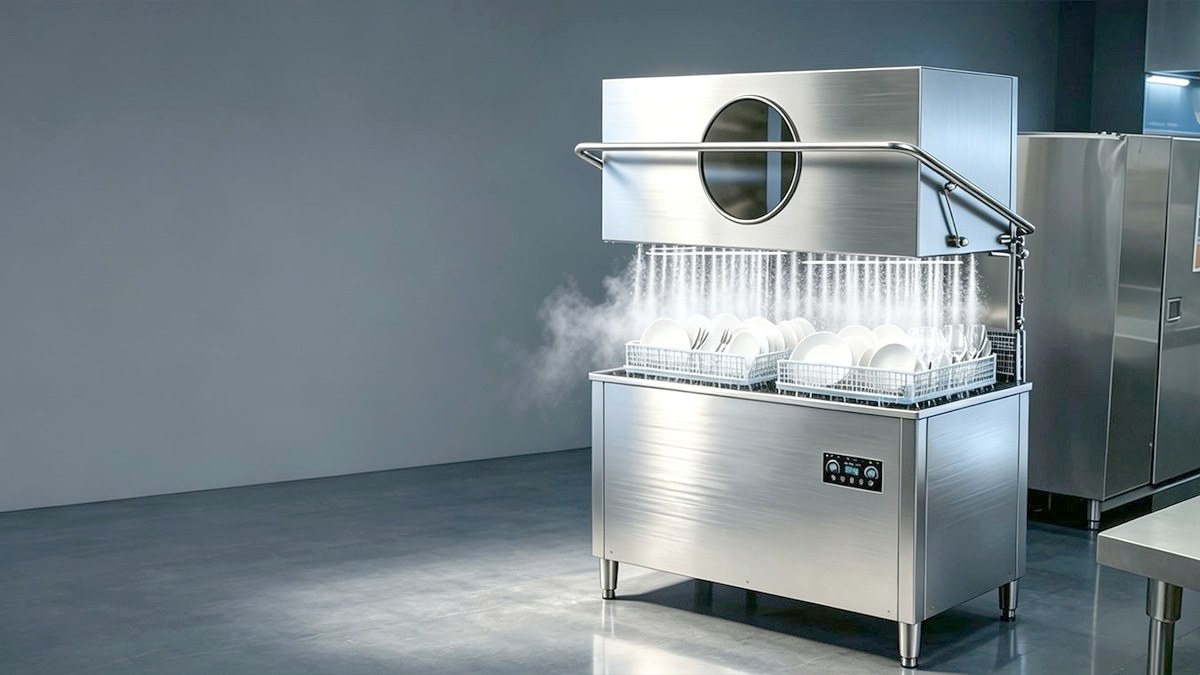
Specifying the wrong machine shows up at the worst possible moment. An undersized wash line creates a queue of soiled plates at the dish pit, forces kitchen porters to rush pre-scraping, and leaves servers waiting for clean tableware during the Friday dinner rush. Worse, a machine that drops its final rinse temperature under continuous load will fail a local health inspection on the spot.
This hood type dishwasher buying guide walks procurement managers and kitchen consultants through a technical specification method. You will learn how to calculate real peak throughput, verify utility requirements on a supplier quote, and test a commercial hood dishwasher before signing the delivery acceptance form.
Table of Contents
- The Operational Cost of a Mis-Specified Hood Type Dishwasher Line
- How to Calculate Realistic Hood Type Dishwasher Throughput
- Five Specification Lines Every Supplier Quote Must Include
- Four RFQ Questions That Expose Unprepared Suppliers
- Factory Direct vs Local Distributor: Choosing Your Supply Path
- Certification and Compliance Checklist for Commercial Buyers
- Pre-Delivery Acceptance Testing Protocol
- Buyer Profile and Configuration Recommendation Framework
1. The Operational Cost of a Mis-Specified Hood Type Dishwasher Line
A dish pit bottleneck stalls the entire kitchen. When a pass through dishwasher cannot keep up with incoming soiled ware, racks stack up on the soiled tabling and spill onto rolling carts. Kitchen staff respond by running the fastest cycle setting even on heavily soiled pans, which forces a second pass and cuts real hourly output in half.
Thermal recovery failure is the hidden risk in mid-sized wash lines. Many machines hit their target sanitising temperature on the first three racks of the morning, then lose heat when a porter loads twenty baskets back-to-back. If the rinse boiler cannot recover between cycles, the final rinse drops below hygiene standards and leaves wet plates stacking up on the clean table. You end up paying staff overtime to hand-dry plates while risking a regulatory shutdown.
2. How to Calculate Realistic Hood Type Dishwasher Throughput
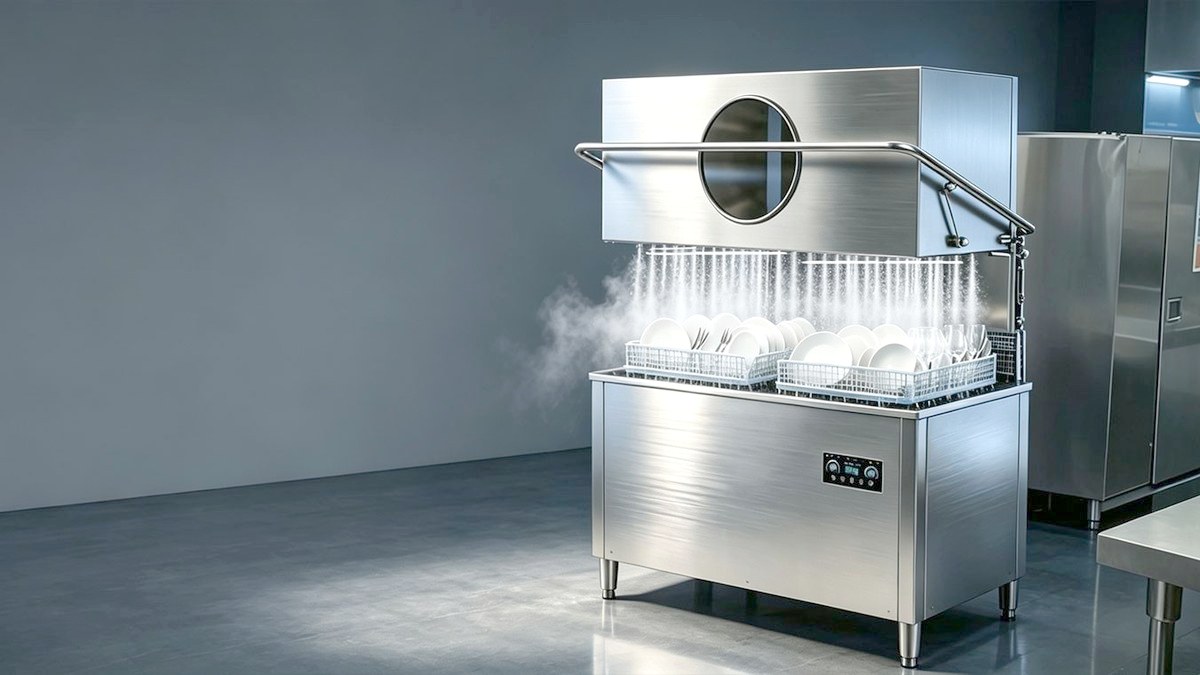
Never size a wash line using daily cover averages. A canteen serving 600 meals across a narrow lunch window puts far more pressure on the dish area than a hotel restaurant serving the same number of guests over twelve hours. You must size the machine for your busiest 60 to 90 minutes of service.
Start by counting the tableware generated per guest during that peak window and converting those pieces into standard baskets. Once you have the base rack count for your peak hour, add roughly 20% headroom to cover staff shift changes, heavily baked-on pans, and glassware surges. Our detailed breakdown on calculating commercial dishwasher racks per hour shows how rack geometry and tableware density change these numbers in practice.
Brochure throughput numbers are theoretical maximums. Manufacturers calculate published output by dividing 3600 seconds by the shortest wash cycle, assuming zero seconds for lifting the hood, sliding the rack, or waiting for the booster tank to reheat. In a working kitchen, operator handling and pre-rinse clearing cut usable output considerably. Always select a machine based on realistic manned output rather than brochure speed.
| Throughput Band | Typical Kitchen Scale | Operational Characteristics | Best For |
|---|---|---|---|
| Low Volume Pass-Through | Small dining rooms or cafes moving up from front-loading units | Intermittent loading with natural pauses between racks for boiler recovery | Sites needing ergonomic straight-line tabling without heavy continuous load |
| Mid-Range Single Hood | Busy full-service restaurants, hotel bistros, and medium school canteens | Continuous loading for 60 to 90 minutes during lunch and dinner rushes | Operations where a single porter works a dedicated pre-wash sink and slide table |
| High-Output / Double Hood | Large institutional canteens, banquet halls, and smaller central kitchens | Non-stop two-operator loading with high demand on electrical recovery and ventilation | High-turn venues that lack the floor footprint for a full rack conveyor machine |
3. Five Specification Lines Every Supplier Quote Must Include
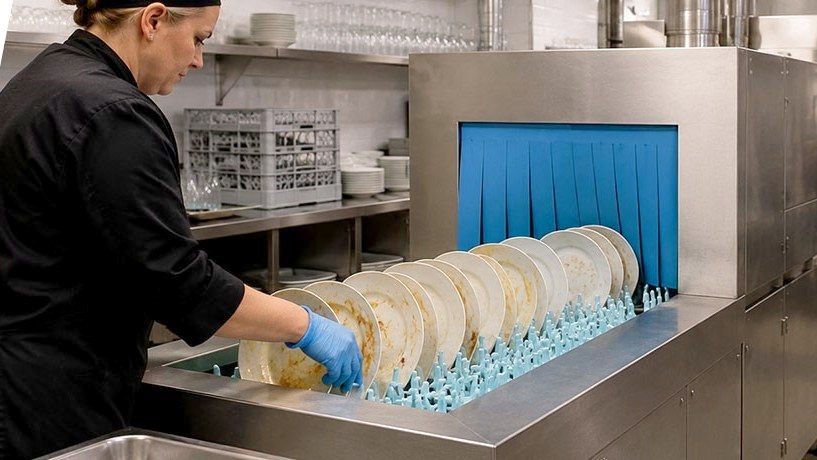
An incomplete quotation is an immediate red flag in foodservice procurement. If a supplier hands you a one-line price with a model number and external dimensions, you have no way to verify whether your building utilities can run the unit. Before issuing a purchase order, require every bidder to state five technical lines in writing.
3.1 Basket Size and Rack Type
The quote must specify the exact rack dimensions and the accessory baskets included in the base price. Confirm whether the slide rails accept standard commercial racks used across your existing kitchens, and verify the internal clearance height under the open hood if you wash oversized sheet pans or tall stock pots.
3.2 Throughput in Baskets Per Hour
Require the vendor to list output across all programmed cycle lengths, not just the shortest flash cycle. A proper specification sheet states the exact cycle durations in seconds and clarifies whether the quoted baskets-per-hour figure depends on a hot water connection or a cold water feed.
3.3 Wash and Final Rinse Temperature Range
Thermal sanitising depends on holding distinct temperature bands in two separate tanks. The wash tank must hold warm water, typically 55-60°C, to emulsify fats without baking proteins onto the plates, while the rinse boiler must reach 82-95°C to kill bacteria and flash-dry the ware. The tank, the cabinet and the basket set should be 304 stainless steel, and the quote should say so, because a lower grade on the wetted parts is the cheapest thing a supplier can leave out. If the machine uses an internal commercial dishwasher booster heater, the quote must state the booster heating power separately from the wash tank element.
3.4 Electrical Supply: Voltage, Phase, and Connected Load
Many installations stall on site because the kitchen only has a single-phase circuit where the dishwasher requires a high-amperage three-phase supply. The quote must state voltage, frequency, phase configuration, total connected load, and whether the wash tank and rinse booster heaters draw power simultaneously or alternately.
3.5 Water Supply Pressure and Drain Requirement
Rinse spray arms rely on incoming water pressure (or a dedicated rinse pump) to drive the spinning nozzles at the right flow rate. Your spec sheet should list the required incoming water pressure range, incoming water temperature assumption, and whether the machine uses a gravity drain or an integrated drain pump. If your floor drain sits higher than the machine outlet, a gravity-drain model will flood the wash area unless mounted on a custom stand.
4. Four RFQ Questions That Expose Unprepared Suppliers
Any reseller can forward a PDF brochure. To separate engineering-capable manufacturers from generalist middlemen, attach these four questions to your Request for Quotation. You can copy this checklist directly into your tender documents.
- What happens to the final rinse temperature under continuous back-to-back loading when fed with cold incoming water? Ask whether the machine features a thermostop function (interlock that pauses the cycle until the booster reaches target sanitising temperature) or if it simply dumps lukewarm water onto the dishes when the boiler falls behind.
- Which critical wear parts are stocked in inventory, and how fast do they ship? Wash pumps, rinse pumps, heating elements, door springs, and PCBs fail eventually in every commercial kitchen. Require a list of recommended spare parts to pack inside the initial shipment.
- Who owns the tooling and CAD drawings if we customise the machine or tabling? If you order OEM modifications, custom hood heights, or bespoke stainless steel inlet tables, clarify in writing whether those design files remain exclusive to your account.
- Exactly which components are covered under warranty, and what is chargeable? Clarify how warranty claims work across borders, whether the supplier provides free replacement parts with the first container order, and how damages from hard water scale or improper chemical dosing are handled.
5. Factory Direct vs Local Distributor: Choosing Your Supply Path
Procurement teams generally weigh two purchasing channels: importing directly from a source factory or buying from a domestic equipment dealer. Each route carries distinct financial and operational trade-offs that affect your total landed cost, and the deciding factor is rarely the unit price. For a fuller breakdown of purchase price versus lifetime operating expense, see our analysis of commercial dishwasher cost in 2026.
Buying direct from a manufacturing factory gives you unit price transparency, direct engineering access for CAD/3D kitchen layout integration, and the ability to request OEM/ODM changes on stainless steel sinks, tables, and wash lines. However, factory orders involve minimum order quantities (MOQs) or container consolidation, ocean freight scheduling, import duty clearance, and self-managed local installation. You should also vet the supplier carefully to confirm they run an actual production floor rather than operating as a trading company with no factory control.
A local distributor is the better choice when you are replacing a single failed unit in an operating restaurant and need delivery within forty-eight hours. You pay a higher unit markup, and you cannot alter the machine design, but the local dealer absorbs the freight logistics and provides an on-call technician for commissioning.
| Evaluation Factor | Source Factory Direct | Local Equipment Distributor | Procurement Recommendation |
|---|---|---|---|
| Unit Pricing & Margin | Factory gate pricing without middleman markups | Higher unit price covering local warehousing and dealer margin | Choose factory direct for multi-unit rollouts, hotel projects, or container consolidation |
| Customisation & CAD | Direct access to factory engineers for custom tabling, voltage, and OEM branding | Limited to standard catalog stock held in the local warehouse | Choose factory direct when integrating bespoke stainless steel sinks and wash lines |
| Lead Time & Logistics | Production lead time plus ocean freight and customs clearance | Immediate dispatch from domestic stock if the model is on the floor | Choose a local distributor for urgent single-unit breakdowns with no buffer time |
| After-Sales & Spares | Spare parts shipped with container orders; local technician hired by buyer | Bundled local labour warranty and domestic parts dispatch | Vet the factory’s spare parts kit policy before importing directly |
6. Certification and Compliance Checklist for Commercial Buyers
Import customs and municipal building inspectors look at documentation before they look at the stainless steel. When evaluating suppliers, verify what their certificates actually cover rather than accepting a logo pasted onto a brochure.
- CE Marking: Mandatory for equipment entering the European Economic Area. Verify whether the CE certificate covers the relevant machinery and low-voltage directives for commercial dishwashing equipment, and request the Declaration of Conformity bearing the exact model nomenclature on your quote.
- RoHS and REACH: These regulations restrict hazardous substances in electrical components and chemical materials. Compliance confirms that internal wiring, circuit boards, and seals meet environmental safety thresholds.
- ISO 9001: This certifies that the factory follows a documented quality management system during manufacturing and assembly. It shows production consistency, though it does not measure the field durability of a wash pump.
Keep in mind that paper compliance does not equal after-sales readiness. A machine can hold valid CE and ISO 9001 paperwork and still become an expensive stainless steel box if the supplier cannot provide wiring diagrams, English service manuals, and replacement heating elements three years after installation.

7. Pre-Delivery Acceptance Testing Protocol
Whether you inspect a batch of machines at the factory before container loading or test a single unit during site commissioning, run a structured acceptance test before releasing final payment.
- Verify electrical supply and dedicated circuit protection. Confirm that the site breaker matches the nameplate amperage and phase specification, and check that all heating elements draw current evenly using a clamp meter.
- Test incoming water hardness before filling the tank. Hard water deposits lime scale inside the booster boiler and clogs rinse spray nozzles within weeks, which insulates the heating coil and causes premature burnout. If water hardness is high, install an external water softener on the feed line immediately.
- Run a continuous-load thermal stability test. Do not test the machine by running one empty rack. Cycle ten to fifteen racks back-to-back without pause to verify that the booster heater recovers fast enough to keep the final rinse within the required sanitising band.
- Measure actual plate surface and rinse water temperature. Place a waterproof digital maximum-registering thermometer or irreversible thermal test strips inside a rack during the continuous-load run. Do not rely solely on the front panel digital display, as a faulty sensor placement can read hot while the spray nozzles deliver cooler water.

8. Buyer Profile and Configuration Recommendation Framework
A hood type dishwasher buying guide can only take you so far, because the specification has to match the service volume, the utilities and the floor space you actually have before the quotation means anything. Not every dish area needs the same specification, and some kitchens should not buy a hood machine at all. Use these decision rules to match your buyer profile to the right equipment setup.
A standard pass-through machine with an atmospheric booster and straight or corner tabling suits full-service restaurants, school canteens, and hotel kitchens running dedicated dish porters during defined meal peaks. The pass-through workflow keeps dirty and clean dishes separated and saves operators from bending down with heavy wet racks.
If you are specifying for a multi-site restaurant chain or an institutional tender in a region with cold winter mains water, specify a machine with high-output three-phase booster recovery and a thermostop interlock. This prevents hurried staff from bypassing the thermal sanitising cycle during peak hours.
However, a hood type machine is the wrong choice for a small coffee shop, a cocktail bar, or a boutique cafe with low hourly rack volume and tight ceiling height. When a hood opens, it releases a plume of steam that requires an overhead extraction canopy and significant floor space for inlet and outlet tables.
If your kitchen washes only a handful of racks per hour and lacks space for tabling, a front-loading undercounter unit will serve you better at a fraction of the utility and installation cost. If you are still weighing the two formats, our hood type dishwasher vs undercounter dishwasher comparison sets out the exact footprint and throughput crossover points side by side.
Request a Quote
If you are preparing an equipment schedule for a new kitchen build, a multi-site restaurant rollout, or a distributor stock order, Dalin can support your specification from the factory floor. We have 18 years of export experience, a 50,000 square metre plant in Dongguan, monthly output of 15,000 units and 74 engineers covering both the drawings and the build. Our engineering team provides CAD and 3D kitchen layout drawings, matches electrical and booster configurations to your local utilities, and manufactures matched stainless steel pre-wash sinks and outlet tabling alongside your pass through dishwasher line. Send us your kitchen floor plan, peak cover count, and available electrical supply to receive a complete technical quotation and spare parts schedule.
FAQ
How much space do I actually need for a hood type dishwasher installation?
You cannot fit a hood machine into a footprint that only matches the cabinet width. Because the workflow is pass-through, you need space for a soiled dish landing table with a pre-rinse sink on the inlet side, the machine itself in the centre, and a clean rack drying table on the outlet side. You also need sufficient ceiling clearance for the hood to lift fully and for an overhead extraction canopy to capture rising steam.
Why does my dishwasher pass temperature checks in the morning but fail during lunch rush?
This happens when the incoming water temperature is too low for the rinse booster heater to recover between continuous cycles. On the first cycle of the day, the booster tank has had plenty of time to heat up. When an operator runs racks back-to-back without pause, cold mains water floods the booster tank faster than the heating element can warm it, unless the machine is sized for cold-water recovery or equipped with a thermal interlock that holds the cycle until the water reheats.
Can I install a pass through dishwasher in a corner instead of a straight line?
Yes. Most hood type machines feature three-sided lifting hoods that allow either straight-line (left-to-right or right-to-left) or 90-degree corner installation. You simply rotate the internal rack guide rails and connect the soiled inlet table at a right angle to the clean outlet table, provided the operator still has clear standing room to lift the hood and slide the baskets.
Do I need an overhead exhaust hood above a commercial hood dishwasher?
In almost all commercial jurisdictions and practical kitchen layouts, yes. Every time the operator lifts the hood at the end of a hot rinse cycle, a dense cloud of steam escapes into the room. Without an extraction canopy or an integrated heat-recovery steam condenser, that moisture condenses on ceilings, creates slip hazards on the floor, and makes the dish area unbearably humid for staff.
What is the most common reason heating elements burn out early on a new machine?
Lime scale buildup from untreated hard water is the primary culprit, followed closely by running the machine with an improperly filled tank. When mineral scale coats the heating element, the metal cannot transfer heat into the surrounding water and overheats internally until the sheath ruptures. Testing local water hardness and fitting a water softener before commissioning prevents this failure.
Should I buy spare parts at the same time as the dishwasher?
If you are importing directly from a factory or operating in a location far from a major equipment hub, it pays to order a consumable and critical spares kit inside the same shipping crate. Adding wash pump seals, a spare heating element, door springs, and a control board to your initial ocean shipment costs very little in freight and prevents weeks of downtime later.