Buying the wrong dishwasher format shows up on the first busy Friday night. Choose an undercounter machine for a dining room that turns eighty covers in an hour, and your kitchen porter spends the evening kneeling on a wet floor while dirty plates stack up across the pass. Choose a pass-through machine for a cramped cafe without checking ceiling height or three-phase power, and you end up with a machine that steams out the room and trips the main breaker.
This hood type dishwasher vs undercounter comparison maps your cover count, room layout, and staffing onto the right machine format. You will see how an upright hood type dishwasher compares against a front-loading cabinet across seven operational metrics before you request supplier quotes.
Table of Contents
- Three Commercial Dishwasher Formats in One Line Each
- Hood Type Dishwasher vs Undercounter: Seven Dimensions Compared
- Kitchen Scenario Matrix by Cover Count and Service Style
- Space, Tabling, and Extraction Constraints
- The Labour Model: Where the Operator Stands and Works
- Concrete Symptoms That an Undercounter Has Outgrown Its Job
- Five-Year Total Cost of Ownership Comparison
- Hood Type Dishwasher vs Undercounter: Format Selection Checklist
1. Three Commercial Dishwasher Formats in One Line Each
Before comparing the two standalone formats in detail, it helps to draw the boundary across all three mainstream commercial washing categories.
- Undercounter Dishwasher: A front-loading cabinet machine that tucks beneath a standard counter, built for bars, coffee shops, and small kitchens where one staff member loads racks intermittently between other tasks.
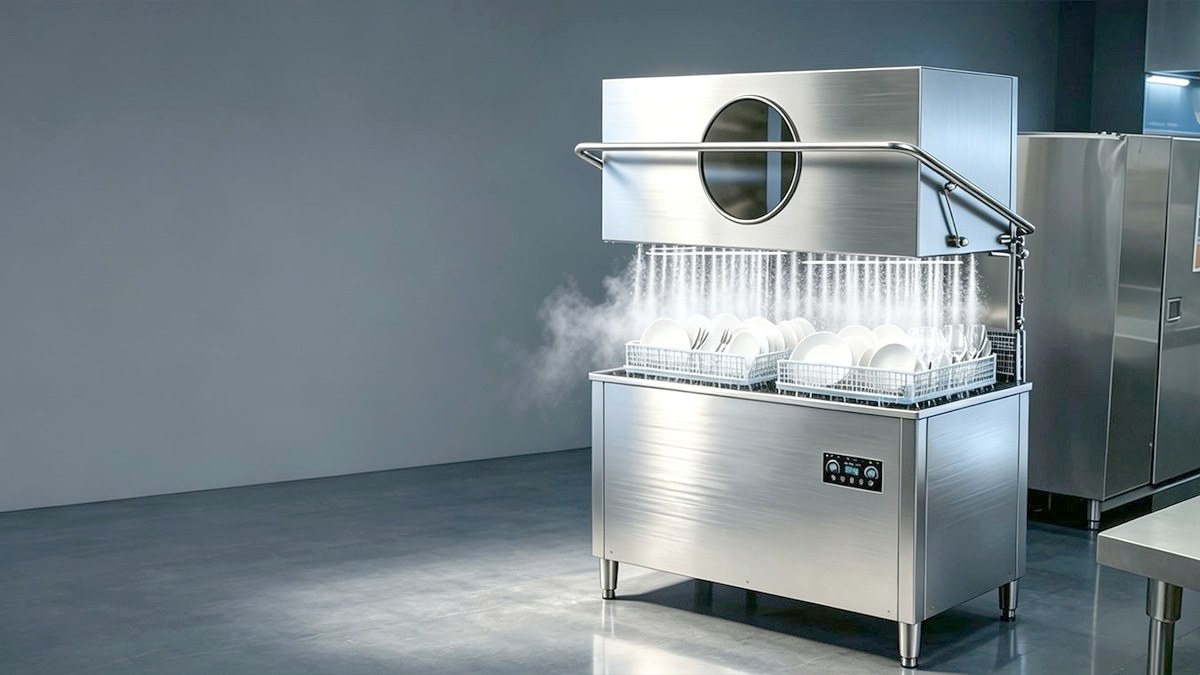
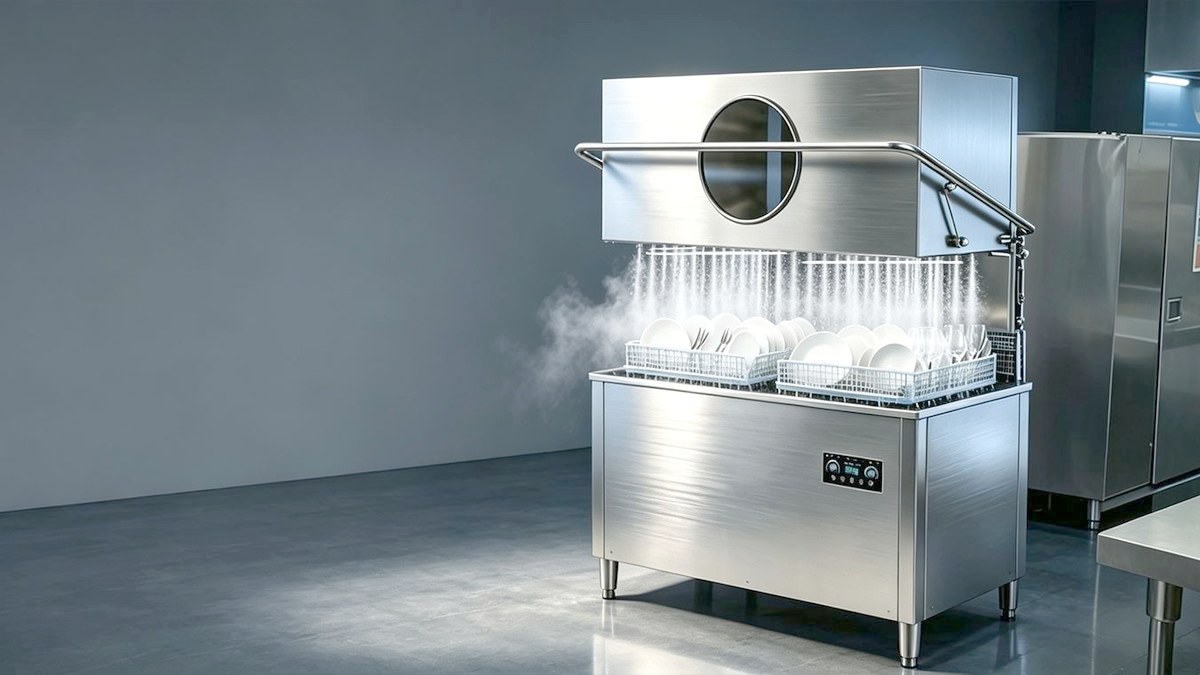
- Hood Type (Pass-Through) Dishwasher: An upright counter-height machine connected to inlet and outlet slide tables, built for full-service restaurants and canteens where a dedicated porter slides racks straight across at waist height.
- Rack Conveyor Dishwasher: A motorized tunnel machine that pulls racks automatically through pre-wash, wash, and rinse zones, built for large banquet operations, hospitals, and central kitchens running hundreds of covers per hour.
2. Hood Type Dishwasher vs Undercounter: Seven Dimensions Compared
Dalin builds the pass-through format in three configurations: the DL-D1 single basket at 60 baskets per hour, the DL-D2 double basket at 120, and the DL-D3 gas-heated variant that raises water temperature with gas instead of electricity. The wash temperature runs 55-60 degrees C with a final rinse at 82-95 degrees C, and the cabinets are 304 stainless steel. Every configuration carries CE, REACH, RoHS and ISO 9001 certification. Keep those numbers in mind as the reference point while you read the comparison below.
Most catalogue comparisons tell you that a pass-through unit is larger and faster without explaining how the two machines behave differently on a utility bill or a staff roster. The biggest hidden gap is not the cabinet size itself. It is the difference between a machine that requires manual bending for every load and a system that turns dishwashing into a horizontal assembly line.
| Comparison Dimension | Hood Type (Pass-Through) Format | Undercounter (Front-Load) Format | Operational Verdict |
|---|---|---|---|
| Baskets Per Hour | Sliding racks straight through cuts loading down to a few seconds between cycles. Our DL-D1 single basket is rated at 60 baskets per hour, the DL-D2 double basket at 120 | Lower real-world output; pulling down the door, stooping, and swapping racks adds heavy handling time | Hood type wins whenever peak-hour volume requires back-to-back cycles for an hour |
| Floor Footprint | Requires the machine footprint plus an inlet pre-rinse table and an outlet drying table | Zero extra floor footprint when tucked beneath an existing bar or prep counter | Undercounter wins in tight bars and galley kitchens with no room for tabling |
| Water Used Per Cycle | Uses a small refill volume per rack pumped from the rinse boiler into the main wash tank | Comparable per-rack refill volume, though failed washes on overloaded racks often force double cycles | Rough tie per single rack, but hood type wastes less water on re-washes of tall items |
| Power Draw | Higher connected load; usually requires a three-phase supply to run high-speed booster recovery | Lower connected load; many units run on single-phase power or lighter three-phase circuits | Undercounter wins in older retail buildings with restricted electrical capacity |
| Labour Hours Per Operating Hour | Low active labour per rack; one porter can pre-scrap the next basket while the current cycle runs | High physical friction per rack; operator stops to open the door, bend down, pull the rack, and reload | Hood type cuts paid porter hours at the end of the night by clearing the pit faster |
| Cost Per Basket | Lower total cost per washed rack at medium-to-high volume because labour represents the largest slice of dish pit expense | Lower fixed cost at low volume, but high labour cost per basket once a porter waits on the machine | Hood type wins on unit economics once daily rack counts justify a dedicated dish operator |
| Best Service Style | Full-service dining rooms, hotel kitchens, and canteens with sharp meal rushes and mixed cookware | Cafes, cocktail bars, small bistros, and satellite pantry stations with steady trickle loading | Match the machine to your busiest 60-minute window rather than your daily total |
To see how cycle times and operator handling shift the real rack output in that first row, read our guide on calculating commercial dishwasher racks per hour.
3. Kitchen Scenario Matrix by Cover Count and Service Style
Cover counts only tell half the story because a three-course dinner generates three times the crockery, cutlery, and sauce pans of a counter-service lunch. When I review a kitchen floor plan, I map the cover count against the service style using these five benchmarks.
- 30 Covers (Cafe, Wine Bar, or Small Bistro): An undercounter dishwasher wins here because the dish volume arrives in small waves and the machine fits directly under the service counter without stealing dining seats.
- 80 Covers (Full-Service Casual Restaurant): A hood type dishwasher usually wins at this threshold because table turns cluster inside a ninety-minute window, and sliding racks across a pre-rinse table prevents a backlog of soiled plates.
- 200 Covers (Busy Restaurant, Hotel All-Day Dining, or School Canteen): A high-output hood type machine (or a twin-hood setup) is the minimum viable choice, as an undercounter unit will hold up table turns and force staff to stay two hours past closing.
- Banquet Hall (Plated Events Served Simultaneously): A hood type machine handles small function rooms, while large halls plating hundreds of covers at the exact same minute should step up to a rack conveyor line.
- Central Kitchen or Institutional Production Unit: A hood type unit works well as a secondary pot-and-utensil washer, while primary tray and container washing belongs on a conveyor machine.
4. Space, Tabling, and Extraction Constraints
The most common layout mistake I see is measuring the width of a standalone pass-through machine, seeing that it is roughly the same width as an undercounter cabinet, and assuming it will drop into the same corner. A pass-through dishwasher is not a standalone box. It is the centrepiece of a three-part stainless steel table system.
To make a pass-through machine work, you must allocate space on the dirty side for a landing table, a scrap hole, and an overhead pre-rinse spray sink. On the clean side, you need room for an outlet roller or slide table long enough to hold at least one or two finished racks so the porcelain can flash-dry in the air before staff stack it.
While you can fold this line around a 90-degree corner to save wall length, you cannot run a hood machine without tabling. Without it, the operator has nowhere to stage wet racks at waist height.
Ceiling height and ventilation create the second physical barrier. Every time an operator lifts the hood at the end of a hot cycle, a column of steam rises straight toward the ceiling. You need enough vertical clearance for the hood canopy to swing fully open, plus an overhead extraction hood (or an integrated steam heat-recovery unit) to pull that moisture out of the room.
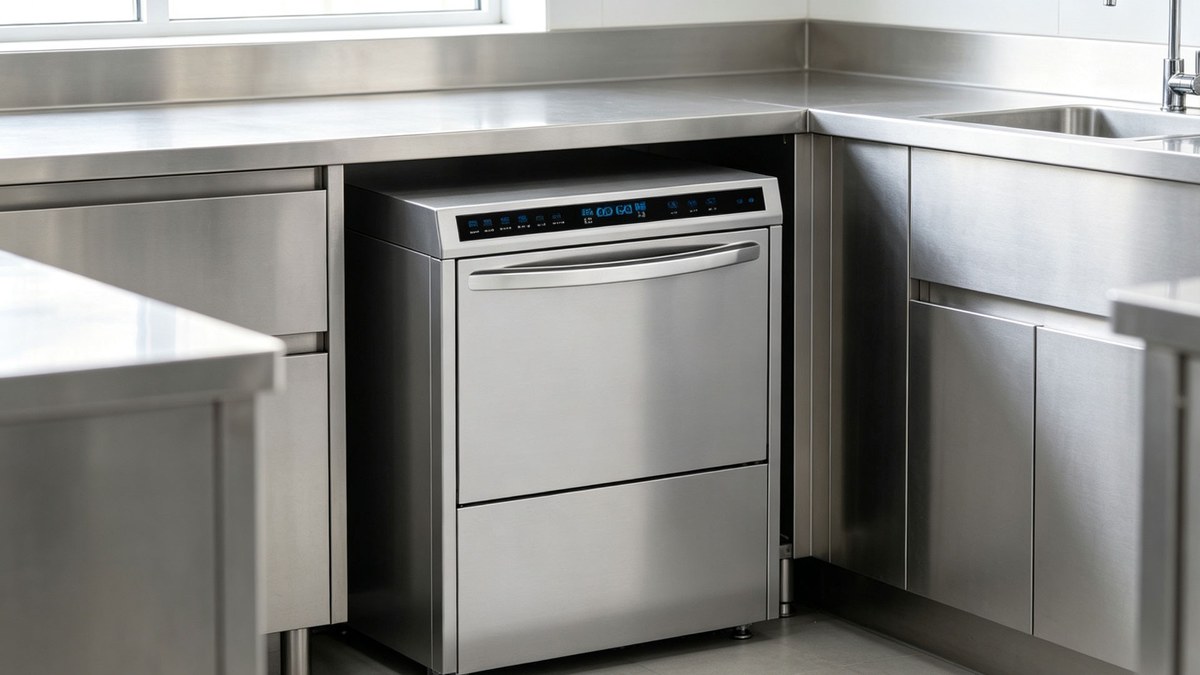
An undercounter machine releases far less steam into the operator’s face and tucks beneath a solid worktop, making it much easier to fit into low-ceilinged basements or front-of-house bar areas.
5. The Labour Model: Where the Operator Stands and Works
Ergonomics directly controls staff turnover in the dish pit. With an undercounter vs hood type dishwasher, the physical motion required from your kitchen porter changes completely.
Operating an undercounter machine is a stop-and-start vertical chore. The operator scrapes a plate at the sink, loads a rack on the counter, bends down to pull open the front door, lifts the heavy wet rack out from ankle height, places it on the counter, bends down again to slide the new rack in, and lifts the door shut.
Doing that fifteen times an hour in a coffee shop is fine. Doing it forty times an hour for an eight-hour shift ruins a porter’s lower back and slows the kitchen down.
A pass-through line turns that motion into a horizontal slide. In a one-operator hood setup, the porter stands between the pre-wash sink and the machine. While rack A washes inside the closed hood, the porter scrapes and sprays rack B on the inlet slide rails. The second the cycle finishes, the porter lifts the counterbalanced hood handle, pushes rack B into the chamber (which simultaneously pushes clean rack A out onto the clean table), and pulls the hood down to trigger the next wash automatically.
In a high-volume two-operator setup, one person stays entirely on the soiled side scraping and loading, while a second person stands on the clean outlet end unloading dry racks, sorting cutlery, and returning empty baskets via an overhead rack shelf. An undercounter machine can never accommodates two operators at once because the open front door blocks the floor space in front of the unit.

6. Concrete Symptoms That an Undercounter Has Outgrown Its Job
Many restaurant owners hold onto an undercounter dishwasher for a year too long after expanding their seating or adding delivery volume. You do not need a stopwatch to know when a front-loader has hit its ceiling. Watch the dish area during a Saturday dinner service for these five physical symptoms:
- Dirty plates stack up on bus tubs on the floor because there is no landing space left on the counter above the machine.
- Kitchen porters pull racks out of the machine before the cycle light turns off, or they run heavily soiled sauté pans on the shortest glasswash setting just to clear the queue.
- Front-of-house servers walk into the kitchen mid-service to hunt for side plates, steak knives, or dessert bowls because clean stock is trapped inside the wash backlog.
- Plates come out of the machine lukewarm and wet after thirty minutes of continuous washing, indicating that the small internal commercial dishwasher booster heater cannot recover temperature fast enough between loads.
- You are paying a kitchen porter for more than forty-five minutes of clock-out time after the kitchen closes just to work through the mountain of kitchen pans and gastronorm trays.
If you see two or more of these symptoms twice a week, buying a second undercounter machine rarely fixes the workflow. You need the straight-line tabling and recovery power of a pass-through system.
7. Five-Year Total Cost of Ownership Comparison
Focusing only on the invoice price of the machine leads buyers into false economies. Over a five-year operating life, the purchase price of the cabinet is much smaller than the combined cost of kitchen labour, electricity, water, detergent, and call-out repairs. We examine these capital and operational numbers in detail in our breakdown of commercial dishwasher cost in 2026.
- Initial Equipment and Installation Cost: The undercounter wins here. It requires no stainless steel inlet/outlet tabling, frequently runs on existing electrical wiring, and often avoids the cost of a dedicated extraction canopy.
- Five-Year Utility Cost (Power and Water): At very low volumes, the undercounter draws less standby power due to its smaller wash tank. Once volume climbs to medium restaurant levels, a properly sized hood machine uses water and power more efficiently per clean plate because taller chamber clearance handles bulky pots and sheet pans that would otherwise require hand-washing in a deep sink.
- Five-Year Labour Cost: The hood type machine wins decisively in any kitchen washing more than a few dozen racks per shift. Cutting one hour of nightly overtime for a single kitchen porter saves enough wage expense in twelve to eighteen months to pay for the entire price difference between the two machine formats.
- Service and Spares Cost: Undercounter machines pushed beyond their intended daily duty cycle suffer frequent door hinge wear, drainage clogs, and overloaded wash pumps. A pass-through machine built with heavy stainless steel hood guides and top-mounted or easily accessible service components costs less to maintain per thousand washed racks when operating under heavy restaurant loads.
| Cost Line Over Five Years | Undercounter | Hood Type | Which Comes Out Cheaper |
|---|---|---|---|
| Initial Equipment and Installation | Lower. No tabling, no dedicated extraction canopy, often runs on existing wiring | Higher. Machine plus inlet pre-rinse table and outlet tabling | Undercounter |
| Utility Cost, Power and Water | Slightly higher standby draw from a smaller tank, and low while volume stays low | Lower per clean plate once volume reaches medium restaurant levels | Depends on volume |
| Labour Cost | Higher. Bending, opening, closing and rack swapping on every cycle | Lower. One-way workflow, one porter can work the line | Hood type |
| Service and Spares | Door hinges, drainage and wash pumps wear faster once pushed past the duty cycle | Heavy duty hood guides and accessible service parts cost less per thousand racks | Hood type |
| Volume Where It Pays | Below roughly 30 covers a day | From 30 covers a day, and clearly ahead past 80 covers | Hood type above the crossover |
8. Hood Type Dishwasher vs Undercounter: Format Selection Checklist
If you are searching for which dishwasher is better for my restaurant, the answer is a function of volume and floor space, not brand loyalty. This commercial dishwasher format comparison exists to narrow the field, not to talk you into a bigger machine. A hood type vs undercounter commercial dishwasher decision usually comes down to three numbers: racks per hour, floor length, and how many people you can put on the line. Work out those three, and the format picks itself.
Before you request quotes or read our complete hood type dishwasher buying guide to write your technical tender, run your site through these four filter questions:
- Do you have the room for tabling and extraction? Measure your dish area wall. If you cannot fit a soiled inlet table, the machine, and a clean outlet table (either in a straight line or around a 90-degree corner), or if you cannot vent steam overhead, you are physically restricted to an undercounter unit.
- Do you have three-phase electrical power available at the dish pit? High-throughput pass-through machines depend on three-phase power to recover rinse boiler heat between fast cycles. If your building only has a light single-phase supply and your landlord refuses an upgrade, check electrical load limits first.
- Do you employ a dedicated kitchen porter during service peaks? If a barista or bartender loads a rack once every twenty minutes between pouring drinks, a hood machine is overkill. If a dedicated staff member stands at the sink continuously during lunch or dinner, give them a pass-through line.
- Do you wash bulky kitchen cookware alongside dining room plates? If you want gastronorm pans, mixing bowls, and stock pots to go through the machine rather than tying up a pot-wash sink, the tall chamber opening and slide-through ergonomics of a hood machine are worth the footprint.
When is the undercounter the genuinely correct choice? If you run a coffee shop, a bar, a small bakery, or a forty-seat dining room with relaxed table turns, tight floor space, and single-phase power, buy the undercounter dishwasher. It will keep up with your covers, tuck cleanly under your worktop, and save your capital budget for cooking equipment. Once your cover count, pan volume, and porter wages cross into full-service restaurant territory, step up to a pass-through line.
Request a Quote
Whether your layout calls for an undercounter unit, a complete pass-through wash line with matched pre-rinse sinks and clean roller tables, or a mix of both formats across a hotel project, Dalin manufactures commercial dishwashing systems direct from our factory floor. We have been building them for 18 years from a 50,000 square metre plant in Dongguan, with monthly output of 15,000 units and 74 engineers on the development team. Our engineering team can review your architectural floor plan, provide 2D CAD and 3D layout drawings, and recommend the right commercial hood dishwasher or undercounter specification for your local power supply and peak cover volume. Contact our team with your kitchen dimensions and meal volume to request a factory quotation.
FAQ
Can I replace an undercounter dishwasher with a hood type machine in the exact same spot?
Rarely without modifying the surrounding counters. An undercounter machine slides beneath a solid worktop, whereas a hood type machine stands at full height and requires open vertical clearance above the cabinet so the hood can lift. You also need to cut or replace the adjacent counter so soiled racks can slide in from one side and clean racks can slide out the other.
Does a hood type dishwasher use more water per rack than an undercounter model?
Per individual wash basket, water consumption is very similar because both formats reuse the water in the main wash tank and only bring in fresh hot water during the final sanitising rinse. While a hood machine requires slightly more water in the morning to fill its larger main wash tank, it uses roughly the same amount of fresh rinse water per cycle once service begins.
Which format is better for washing tall wine glasses and beer mugs?
For delicate stemware behind a bar, a dedicated undercounter glasswasher is usually the better tool because it runs slightly gentler wash pressures and fits right behind the bartender. However, if you are washing high volumes of banqueting glassware in a back-of-house dish pit, a hood type machine works well provided you use compartmented glass racks with the correct height extenders and adjust the chemical rinse aid for spot-free drying.
Can a hood type dishwasher wash kitchen pots and baking trays?
Yes, within its hood clearance height. Because a pass-through machine has no front door hinges blocking the opening and offers higher vertical clearance than most undercounter cabinets, porters can slide standard gastronorm containers, colanders, chopping boards, and medium stock pots straight onto open flat racks.
Why do undercounter dishwashers take longer between cycles in a busy kitchen?
Two factors slow down an undercounter unit during a rush: operator ergonomics and booster recovery. First, the operator has to bend down, open the door, pull out the clean rack, lift it onto a counter, and bend down again to load the next rack. Second, compact undercounter machines often run on lower electrical wattage, which means the rinse boiler needs extra seconds between washes to bring cold incoming mains water up to sanitising temperature.
Is it better to buy two undercounter dishwashers or one hood type dishwasher?
If you have the wall length and ceiling height for inlet and outlet tables, one hood type dishwasher with proper tabling will outperform two undercounter machines in a restaurant dish pit. Two undercounter units still force the porter to bend down for every rack and leave nowhere to stage dirty and clean baskets efficiently, whereas a single pass-through line establishes a fast, continuous one-way workflow.