Why Your Commercial Kitchen Design Is a Business Decision
Your commercial kitchen design will run — and cost you money — for years. Most design and equipment choices are made once and live for eight years or more, so the real price is never the invoice you sign. It’s the Total Cost of Ownership (TCO): purchase price plus energy, water, consumables, maintenance, downtime, and replacement over the machine’s working life. Operators who shop on sticker price alone end up paying the most — and this guide exists to make sure that isn’t you.
The pattern never changes: a bargain-priced fryer or dishwasher saves money on paper, then quietly burns it back through higher energy use, frequent repairs, and lost service hours when it fails mid-shift. Plan your commercial kitchen design the way you’d plan a vehicle you depend on — not the way you’d buy a disposable appliance.
Step 1: Start Your Commercial Kitchen Design with the Menu
Experienced kitchen consultants agree on the single most common mistake in new projects: designing equipment before the menu is finalized. Equipment should follow your menu and projected volume, not the other way around.
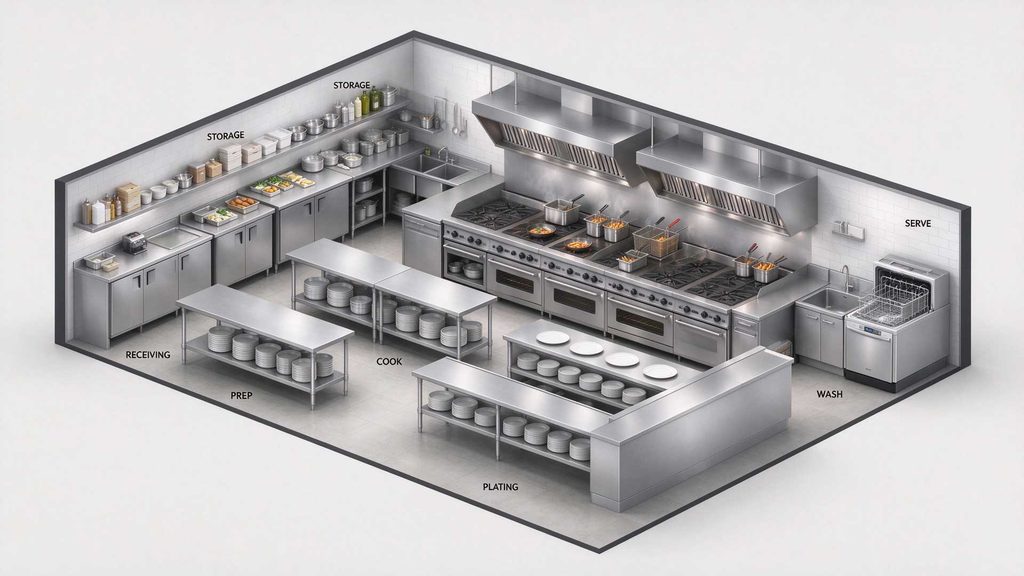
Map your operation as a flow:
Receiving → Cold/Dry Storage → Prep → Cooking → Holding/Plating → Service → Warewashing
Before you spec anything, answer three questions:
- What are you cooking, and how often? A chicken-focused fast-food outlet needs high-volume pressure fryers; a fine-dining kitchen needs precision ranges and combi ovens.
- What’s your realistic peak volume? Size for demand you’ll actually see in the first 12–24 months, not an idealized second-stage volume. Overbuying “for future growth” ties up capital and inflates utility bills.
- Who will operate it? A machine your team can’t run properly is a liability. Match complexity to operator skill — or budget for training.
Step 2: Audit Your Site Before You Lock In Commercial Kitchen Design
This is where new operators lose the most money, because it’s avoidable. The typical failure chain: equipment ordered → installation incompatible → adaptation → construction → delayed opening → extra cost. Verify before you commit:
- Power supply. Enough electrical capacity? Electric cooking draws serious load — confirm panel capacity and conductor sizing with a licensed electrician.
- Gas supply. For gas ranges or fryers, confirm gas type, pressure, and line sizing on site.
- Water and drainage. Confirm supply pressure, flow, floor drains, and grease-interceptor needs. Dishwashers and steam equipment are water-hungry.
- Ventilation. Grease-producing equipment needs a Type I exhaust hood sized for the equipment beneath it. In North America, codes such as NFPA 96 set minimum exhaust rates — typically 150–200 CFM per linear foot for light-duty, 300–400 CFM for heavy-duty lines, up to 400–550 CFM for extra-heavy duty. Undersize the hood and capture fails on your first service.
- Local codes and certifications. UL/ETL (North America), CE (EU), NSF, and local health/fire rules decide what you may legally install. “It works in our market” is not a certification.
Step 3: Know Your Equipment Options, Zone by Zone
Cooking Line: Gas vs. Electric, Fryers, and Combis
- Gas vs. electric. Gas stays popular where fuel is cheap and heat response matters. But electric equipment is far more efficient at the point of use — studies show electric cooking reaches around 90% energy-use efficiency versus roughly 40–60% for gas — with better precision and less waste heat.
- Open burners & ranges. Flexible, but demand skilled operators and the most ventilation.
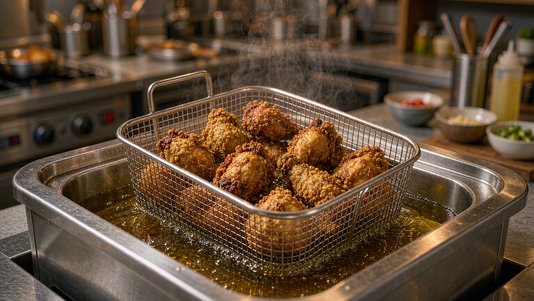
- Deep fryers vs. pressure fryers. Open fryers suit general frying. Pressure fryers seal in moisture, cook faster at lower oil temperature, and are the standard for high-volume fried chicken — with lower oil usage per day.
- Combi ovens. One unit replaces a steamer and a convection oven, shrinking footprint while adding steam, hot-air, and combination modes.
- Specs to compare: output (pieces or kg/hr), energy input (kW or BTU/hr), oil capacity, recovery time, water use.

Alt: commercial kitchen design — high-volume pressure fryer station
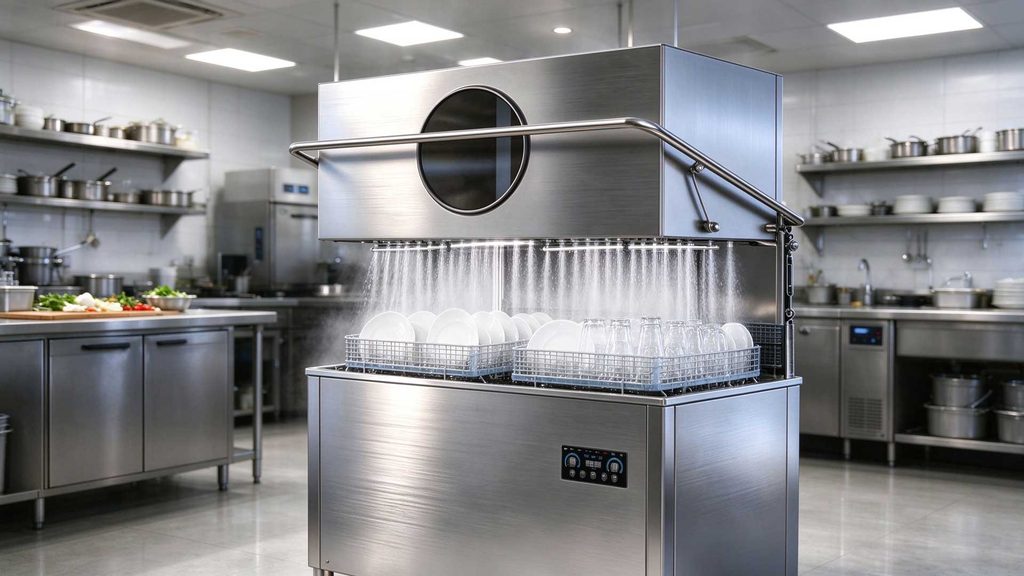
Warewashing: Don’t Underestimate the Dishwasher
Often the most underestimated zone. A slow or unreliable dishwasher backs up your whole service.
- Undercounter dishwashers suit cafés and small kitchens.
- Door-type dishwashers handle mid-volume with short cycles.
- Conveyor / flight-type are for high-throughput and institutional feeding.
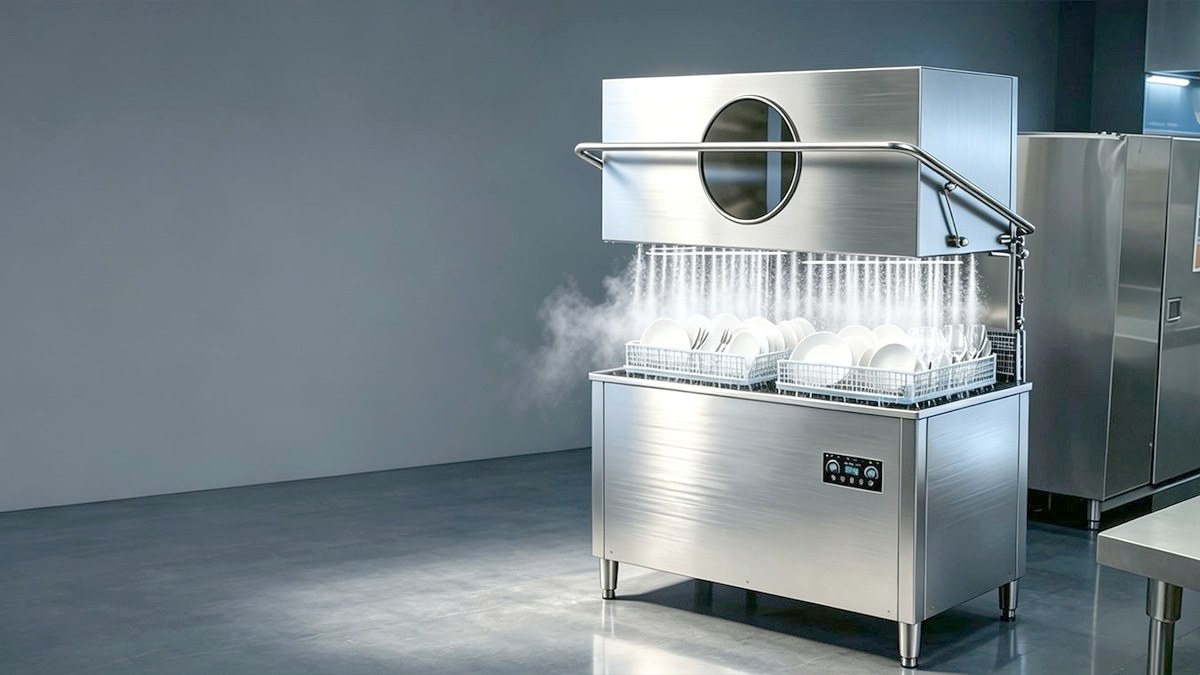
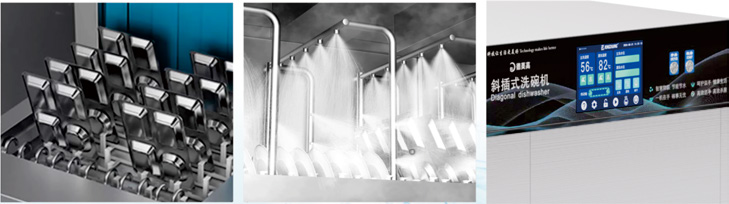
Compare cycle time, racks per hour, and water per cycle. Cheap machines with long cycles and high water use quietly raise your utility and labor bills every shift. Match capacity with our commercial dishwashers.
Ventilation & Cooling: The Compliance Zone
- Type I hood with ductwork. The code-preferred solution for grease-producing equipment — but the duct run can cost tens of thousands of dollars.
- Ventless (recirculating) hoods. UL 710B-listed systems eliminate the duct run. The ventless cooking equipment market is projected to grow from roughly $4.27 billion in 2025 to $7.82 billion by 2034, driven by buildings where rooftop ducting is impossible.
Beyond exhaust, the kitchen itself needs cooling — cooking lines radiate serious heat. See our commercial kitchen HVAC solutions for peak-service comfort.
Power & Electrical Infrastructure
With electrification, the electrical room becomes part of kitchen design. Confirm panels, breakers, and cabling are sized for the full connected load, and plan for voltage stability across heavy machines. In unreliable grids, operators add energy storage & power systems so a blackout doesn’t shut down service.
The 12 Mistakes That Inflate Your Commercial Kitchen Design Costs
- Buying before the menu is final. Finalize the menu and volume forecast first.
- Shopping on sticker price, not TCO. Compare energy, water, consumables, and service over the machine’s life.
- Ignoring workflow. A dish station far from the cookline, or a prep table blocking the walk-in, costs labor every shift.
- Wrong sizing — both directions. Oversized wastes capital and energy; undersized chokes at peak.
- Skipping the utility audit. Gas, power, water, drain, and ventilation must be verified on site first.
- Ignoring certifications. No UL/ETL/CE/NSF mark for your market = no permit, no insurance, forced replacement.
- Underestimating energy and water bills. A “cheap” high-energy machine can cost more in one year than the price you saved. Check ENERGY STAR for efficient models.
- No spare parts or after-sales plan. Buy from suppliers who stock parts and ship fast — downtime is revenue lost.
- Panic-buying in emergencies. Replacing a failed fryer mid-shift with the first available unit ends in the wrong size and features.
- Ignoring operator capability. Complex equipment without training becomes expensive idle iron.
- Speculating on future growth. Buying for volume you may reach in three years starves you of cash today.
- Forgetting installation cost. Include delivery, rigging, ductwork, gas, electrical, and commissioning in every comparison.
Your Pre-Purchase Checklist
| Check | What to verify |
|---|---|
| Menu & volume | Equipment matches the actual menu and first-year peak demand |
| Workflow | Equipment follows receiving→prep→cook→serve→wash |
| Utilities | Power, gas, water, drainage, grease interceptor confirmed |
| Ventilation | Type I/II hood correctly sized (CFM per linear foot for your duty) |
| Certifications | UL/ETL, CE, NSF or local marks on every unit |
| TCO | Energy + water + consumables + service over 8+ years |
| Spare parts | Availability, lead time, local service coverage |
| Installation | Full installed cost: ductwork, gas, electric, rigging, commissioning |
| Training | Operator training included or available |
| Supplier | Factory/distributor with references, written warranty, parts commitment |
Questions to Ask Any Supplier Before You Sign
- “What is the total installed cost, including delivery, rigging, and connections?”
- “What certifications does this exact model carry, and for which markets?”
- “What are the energy and water consumption figures — can you show the spec sheet?”
- “What’s your spare-parts availability and lead time?”
- “What does the warranty cover, and who services it in my market?”
- “Can you provide references from operators running this equipment at similar volume?”
The suppliers who answer clearly and in writing are worth your business. The ones who only talk about price are telling you what their machine is — not what it will cost you.
Ready to spec your kitchen? Send us your menu, your volume, and your floor plan. We’ll come back with a zone-by-zone proposal, honest sizing, and a full TCO comparison — straight from the factory.