
A hood-type dishwasher gives you fast, sanitizing cycles without the footprint of a conveyor. This guide explains how it compares with undercounter, door-type and conveyor machines, and shows you how to pick a hood-type model that keeps clean dishes flowing at peak service.

By Dalin Kitchen Equipment · Commercial kitchen equipment supplier
Quick answer: what to look for in a hood-type dishwasher
- Buy a hood-type dishwasher if you need fast cycles and higher throughput than an undercounter machine.
- It needs a counter or stand to sit on, so plan the height and clearance.
- Prioritize fast cycle time, sanitizing rinse and water efficiency.
- If you need continuous high volume, compare door-type or conveyor machines instead.
The dishwashing problems that slow your service
In busy restaurants, cafes and bars, dishes arrive faster than a single slow machine can handle. When the wash line falls behind, plates stack up, the kitchen runs short of clean dishes, and service slows exactly when it should be fastest.
The pain points Dalin solves most often:
- Dishes pile up at peak. A slow machine cannot clear racks fast enough during rush.
- Staff spend hours at the sink. Manual washing ties up labor that should be serving guests.
- Space is limited. A full conveyor line is too big for most small and mid-size kitchens.
- Results stay inconsistent. Hand washing and rushed cycles lead to rewashing and wasted water.
- Speed and capacity must balance. You need faster cycles without a huge footprint.
What is a commercial hood-type dishwasher?
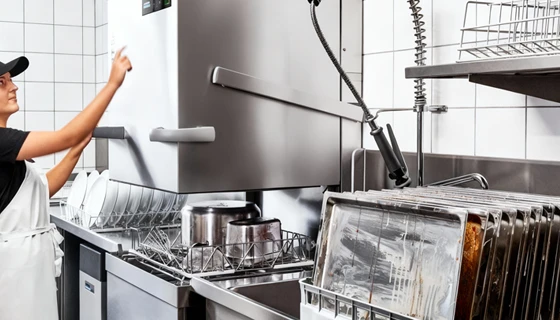
A commercial hood-type dishwasher — also called an open-top dishwasher — sits on a counter or stand with a lifting hood. You load a rack, pull the hood down, and the machine runs a fast wash-and-rinse cycle, often around a minute per rack. As a result, it delivers fast cycles and steady throughput in a compact footprint, which makes it a strong middle option between undercounter and conveyor machines.
Equipment comparison: hood-type vs undercounter vs door-type vs conveyor
First, compare the main commercial dishwasher types. The table below shows where each one fits best.
| Type | Throughput | Space | Cost | Best for |
|---|---|---|---|---|
| Undercounter | Lowest; a few minutes per rack | Tucks under a counter | Lowest entry cost | Small kitchens, cafes, bars |
| Hood-type (open-top) | Fast; ~1 minute per rack | Compact countertop / stand | Mid | Small to mid kitchens needing speed |
| Door-type (rack) | Mid; larger batches | Needs floor space | Mid to higher | Mid-volume restaurants and canteens |
| Conveyor | Highest; continuous flow | Largest footprint | Highest | High-volume hotels, canteens, large restaurants |
In short, choose a hood-type dishwasher when you need speed without a big footprint; step up to a conveyor when volume becomes continuous.
How to choose the right hood-type dishwasher
- + Match capacity to volume. Size rack capacity and cycle time to your busiest service, not the average day.
- + Plan the counter or stand. Confirm height, clearance and a solid base, because the machine sits on top.
- + Check the cycle time. A fast cycle keeps racks moving; a slow one becomes the bottleneck.
- + Look at sanitizing. A high-temperature final rinse keeps dishes hygienic and avoids re-washing.
- + Compare water and energy use. Efficient cycles lower running costs in daily use.
- + Choose build quality. Food-grade stainless steel and reliable spray arms resist daily commercial wear.
Common mistakes buyers make
Moreover, avoiding these mistakes will save you rework and downtime:
- ✗ Buying for average days. A machine that lags on your busiest hour still creates queues.
- ✗ Ignoring the stand. A hood-type unit needs a solid base and enough height to open fully.
- ✗ Forgetting the pre-rinse. Pair it with a pre-rinse sink so heavy soil does not overload the machine.
- ✗ Underrating the rinse. A weak final rinse forces re-washing and wastes water.
- ✗ Skipping service. Parts availability matters as much as the machine itself.
What to check before you buy
| Criterion | Why it matters |
|---|---|
| Cycle time vs peak volume | Undersized or slow machines queue up at rush hour. |
| Counter / stand fit | It sits on top, so confirm height, clearance and a solid base. |
| Sanitizing rinse | High-temperature rinse keeps dishes hygienic and ready to use. |
| Water & energy efficiency | Efficiency lowers daily running costs. |
| Build quality & materials | Stainless steel stands up to constant commercial use. |
| Service & spare parts | Downtime on the wash station stalls the whole kitchen. |
Frequently asked questions
What is a hood-type dishwasher?
A hood-type dishwasher, also called an open-top dishwasher, sits on a counter or stand with a lifting hood. You load a rack, pull the hood down, and the machine runs a fast wash-and-rinse cycle. Its fast cycles suit kitchens that need speed and steady throughput.
How does a hood-type dishwasher compare with an undercounter dishwasher?
An undercounter dishwasher fits beneath a counter and saves floor space but handles a smaller rack capacity. A hood-type dishwasher sits on a counter or stand and cycles faster with higher throughput. Choose undercounter for space, hood-type for speed.
How fast is a hood-type dishwasher cycle?
Many commercial hood-type dishwashers finish a full wash-and-rinse cycle in roughly a minute per rack, though the exact time varies by model and settings. Always check the specification sheet for the machine you plan to buy.
Who should buy a hood-type dishwasher?
Small to mid-size restaurants, cafes and bars with steady volume gain the most. It suits kitchens that need fast cycles and higher throughput than an undercounter machine but do not need the continuous volume of a conveyor.
Does a hood-type dishwasher sanitize dishes?
Yes, when configured correctly. Commercial hood-type models use a high-temperature final rinse to reach sanitizing temperature, so dishes come out hygienic and ready to use without re-washing.
Why Dalin for hood-type dishwashers
Fast-cycle warewashing that fits your kitchen
Dalin Kitchen Equipment supplies commercial hood-type dishwashers for restaurants, cafes and bars. We help you match cycle time and capacity to your peak service, plan the counter or stand it sits on, and choose models with a strong sanitizing rinse and efficient water use. In addition, we support you with after-sales service and spare parts. If you need continuous high volume, we will recommend the conveyor or door-type machine that suits you better.
Explore the rest of your kitchen

A dishwasher works best as part of a planned wash station. For the bigger picture, compare all types in our commercial dishwasher buying guide, or see how washing fits into an efficient kitchen in our kitchen design and workflow guide.
Keep clean dishes flowing, even at peak
The right hood-type dishwasher gives you fast, sanitizing cycles in a compact footprint. First, size capacity and cycle time to your busiest hour; then plan the counter or stand; finally, choose a machine with a strong sanitizing rinse and efficient water use. Do this, and clean dishes stay available through every service instead of piling up at the sink.