
Learn how to choose commercial cooking equipment for your restaurant, hotel, or central kitchen. Compare gas ranges, griddles, and automated machines by output, fuel, and workflow—with a full selection checklist.
Slug: commercial-cooking-equipment-buying-guide
![Commercial cooking equipment stainless steel gas combi range in a professional restaurant kitchen]
A well-equipped kitchen starts with the right commercial cooking equipment. From gas ranges and flat-top griddles to automated wok machines and rotisserie ovens, every piece affects your output, food quality, and labor cost. Choosing the wrong equipment means bottlenecks during rush hour, inconsistent dishes, and expensive replacements. This guide walks you through every type of commercial cooking equipment you need, how to match it to your operation, and what to look for in a manufacturer.
What Is Commercial Cooking Equipment?
Commercial cooking equipment refers to heavy-duty, high-output cooking appliances built for professional kitchens—restaurants, hotels, school cafeterias, central kitchens, and institutional dining. Unlike residential appliances, commercial units are engineered for continuous operation, higher heat output, and food-safety compliance.
The category includes:
- Ranges & stoves — gas combi-ranges, electric oven ranges
- Griddles & grills — vertical griddles, lava rock grills, BBQ grills
- Specialty machines — automatic wok machines, automatic pasta cookers
- Ovens — rotisserie ovens, vertical rotisserie grills
- Pans & kettles — tilting braising pans, jacket boiling pans
- Induction cooking — induction wok ranges
Types of Commercial Cooking Equipment: What You Actually Need
Not every kitchen needs every appliance. Here is how the main categories map to different menus and workflows:
| Equipment Type | Best For | Fuel Options | Key Benefit |
| Gas combi-range | General line cooking, wok + griddle | Gas | Versatility, high heat, one unit does many jobs |
| Flat-top / vertical griddle | Breakfast, burgers, pancakes | Gas / electric | Large surface, fast batch cooking |
| Automatic wok machine | Stir-fry volume, central kitchens | Gas / electric / induction | Consistent results, labor savings |
| Automatic pasta cooker | Pasta, noodles, dumplings | Gas / electric | Hands-free, consistent doneness |
| Rotisserie oven / grill | Roasted chicken, kebabs, meats | Gas / electric | Even cooking, high presentation value |
| Tilting braising pan | Soups, sauces, braising in bulk | Gas / electric | Easy pouring, large capacity |
| Jacket boiling pan | Stocks, soups, bulk liquids | Steam / electric | Precise temperature control |
| Induction wok range | High-end, fast & clean cooking | Electric (induction) | Energy-efficient, precise, no open flame |
Explore the full lineup on our commercial cooking equipment page.
How to Choose Commercial Cooking Equipment: 6-Step Checklist
- Define your menu and cooking methods
Your menu decides your equipment. A burger joint needs griddles and fryers; an Asian kitchen needs wok ranges; a deli needs ovens and rotisseries. List every cooking method on your menu before buying anything.
- Match output to your peak-hour demand
Size equipment for your busiest hour, not your daily average—then add a 20% buffer. A machine running at 100% capacity all day will fail fast. Look for rated output that gives you headroom.
- Choose the right fuel for your market
- Gas (LPG / natural gas): Cheapest running cost, high heat. Common in Europe, Asia, Africa, Middle East, and South America.
- Electric / induction: Cleaner, safer, easier to install—no venting for gas. Preferred where gas is expensive or restricted.
- Dual-voltage models: If you source internationally, confirm whether the equipment runs on 110V/120V (North America) or 220–240V (most other markets).
- Check build quality and materials
Look for food-grade stainless steel bodies, heavy-duty burners, and quality thermostats. Cheap units corrode, overheat, and die within a year. A properly built commercial stove lasts 10+ years.
- Plan space, power, and ventilation
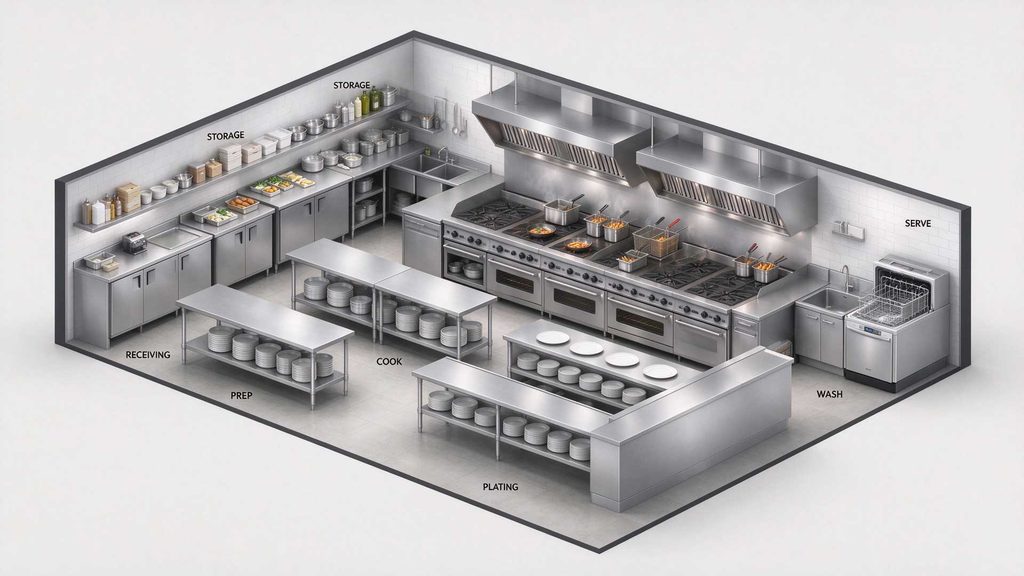
Measure your kitchen, confirm your electrical/gas supply, and plan exhaust hoods before purchase. Use a CAD kitchen layout to avoid buying equipment that doesn’t fit your line.
- Verify certifications for your market
Confirm the equipment meets the standards your country requires:
- Europe: CE, RoHS, REACH
- North America: NSF/ANSI, ETL/UL
- Global: ISO 9001
Commercial Cooking Equipment by Application
Restaurant kitchens
Diverse cooking styles and high-frequency service demand reliable ranges, griddles, and fryers that keep food quality consistent through lunch and dinner rushes.
Hotel kitchens
Hotels need stable, multi-functional equipment for breakfast buffets, banquets, and 24/7 room service. Heavy-duty ranges and ovens are essential.
Supermarkets & retail food areas
In-store commercial cooking equipment lets supermarkets prepare fresh hot food efficiently, supporting ready-to-eat meals and consistent deli quality.
School cafeterias
Safe, high-capacity preparation is critical for daily dining demands while meeting strict hygiene standards.
Central kitchens & food processing centers
Automated machines like the automatic wok machine support batch cooking, automation, and efficient workflow management at scale.
Canteens & staff dining facilities
Institutional dining needs high output, efficiency, and consistency—built for large-scale meal preparation.
Why Buy from a Commercial Cooking Equipment Manufacturer Direct?
When you buy from a factory-direct manufacturer instead of a middleman distributor, you typically save 20–30% on landed cost and gain control over customization. Here is what to look for:
| Capability | Why It Matters |
| Source manufacturing | Direct pricing, stable supply, full quality control |
| OEM / ODM service | Private-label branding and custom designs for your market |
| Factory capacity | High monthly output for large engineering projects |
| CAD & 3D kitchen design | Optimize your kitchen layout before production |
| Project support | Equipment matching, layout optimization, on-site install |
| Certifications | CE, REACH, RoHS, ISO 9001 for smooth customs clearance |
Learn more about our manufacturing capabilities and full product range on our commercial cooking equipment page.
Commercial Cooking Equipment FAQ
What are the different types of commercial cooking equipment?
The main types are gas ranges, electric ranges, flat-top griddles, grills, ovens (including rotisserie ovens), pasta cookers, fryers, tilting braising pans, jacket boiling pans, and automated machines like automatic wok machines and induction wok ranges. Choose based on your menu and cooking methods.
What is the difference between commercial and residential cooking equipment?
Commercial cooking equipment is built for continuous, heavy-duty use with higher heat output, larger capacities, and food-safety compliance. Residential equipment is lighter, lower-output, and not designed for back-to-back professional service.
Gas or electric commercial cooking equipment: which is better?
Gas offers cheaper running costs and higher heat, ideal for wok cooking and high-volume lines. Electric and induction are cleaner, safer, and easier to install where gas is costly or restricted. Your choice depends on your menu, utility costs, and local regulations.
How much does commercial cooking equipment cost?
Prices vary widely by type and capacity. A basic griddle or range can cost a few hundred dollars, while heavy-duty automated machines and industrial ovens range from a few thousand dollars up. Factory-direct sourcing typically reduces cost by 20–30% versus distributor pricing.
How do I size commercial cooking equipment for my kitchen?
Size for your peak-hour output, add a 20% buffer, and match fuel and voltage to your site. Plan space, power, and ventilation with a CAD kitchen layout before ordering to avoid mismatched equipment.
What certifications should commercial cooking equipment have?
For Europe, look for CE, RoHS, and REACH. For North America, require NSF/ANSI and ETL/UL. Globally, ISO 9001 signals a quality-managed production process. These also ease customs clearance.
How long does commercial cooking equipment last?
A well-maintained commercial range, griddle, or oven typically lasts 8–15 years. Automated machines may have shorter component life, but quality units with stainless steel construction and replaceable parts last well over a decade.
What is the lead time for commercial cooking equipment?
Standard models usually ship within 1–2 weeks of order confirmation. Customized equipment and large-scale projects take longer, so confirm a clear delivery schedule before production begins.